

Electron Dot Structure For Ncl3
The chemic formula NCl3 represents the inorganic chemical compound Trichloramine. It is as well commonly known as Nitrogen Trichloride. It is an oily, yellow liquid with a stiff, pungent scent.
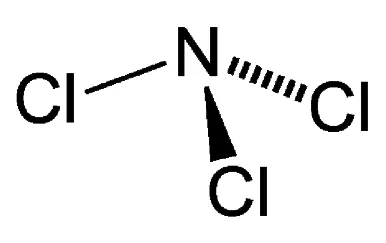
Trichloramine is one of many DBPs (Disinfection by-products) present in modern swimming pools. Information technology is formed in small-scale amounts when Chlorine reacts with urea in sweat and urine from swimmers and bathers. Furthermore, it turns into a gas by virtue of its volatile nature.
It is highly explosive and toxic in concentrated amounts [ one ]. Research into DBPs at swimming pools holds Trichloramine responsible for instances of asthma amidst swimmers and staff [ 2 ]. Trichloramine in the air causes middle irritation, commonly observed after pond. The distinct smell of Chlorine in pools is attributed to the presence of Trichloramine in the air.
The concrete properties of Trichloramine are given below:
| Name of the molecule | Trichloramine (NCl3) |
| No. of valence electrons | (5 10 1) + (vii x 3) = 26 valence electrons |
| Hybridization of the key atom | sp3 |
| Bail Angles | 107.1° |
| Molecular Geometry of NClthree | Trigonal Pyramidal |
NCl3 Lewis Structure
Lewis dot structures are schematic representations of valence electrons and bonds in a molecule. They're usually the first figures drawn to stand for molecules and empathise their properties. Dots and lines are used in the Lewis structure to describe electrons and chemic bonds, respectively.
First, the number of valence electrons nowadays in the structure must be determined.
Valence Electrons
Valence electrons are those electrons that lie in the outermost shell of the atom. Here, the forcefulness of attraction from the nucleus on these electrons is weak. Thus, valence electrons break free to participate in the chemical bail formation or electron substitution.
Each atom in the molecule contributes a set number of valence electrons depending upon their atomic number and position on the periodic table. These valence electrons are used as edifice blocks in the Lewis structure.
Trichloramine comprises a unmarried Nitrogen atom and a set up of Chlorine atoms. Let usa make up one's mind the number of valence electrons present in this molecule.
Nitrogen is in group five of the periodic table with the electronic configuration 1s22s22p3. Therefore, the solitary Nitrogen cantlet in NCl3 contributes 5 x 1 = v valence electrons.
Being in grouping 7 of the periodic tabular array, chlorine has seven valence electrons. Chlorine's electronic configuration is given past [Ne]3s23p5. The possibility of electrons in its d crush makes it hypervalent. Therefore, the three Chlorine atoms present contribute 7 x 3 = 21 valence electrons.
Therefore, the total number of valence electrons present in Trichloramine(NCl3) is given past:
five[N] + 21[Cl] = 26 valence electrons
Lewis Structure Assembly
20-six valence electrons are available equally building blocks for the Lewis structure. Next, we form a skeletal structure past determining the central atom(s). Nitrogen is the least electronegative atom in the group and, therefore, takes its place as the central atom. The fix of Chlorine atoms surrounds the central Nitrogen atom. This is illustrated in the figure below:
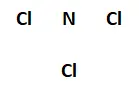
The valence electrons slot right in between the atoms to form chemical bonds. This is again shown in the figure below:

The cherry dots in the structure represent valence electrons. When distributing valence electrons, the aim is to ensure each cantlet fulfills its outer shell requirements, i.due east., adheres to the octet rule. The remaining valence electrons, xx in this case, are distributed amidst the atoms to fulfill the aforementioned outer crush requirements.
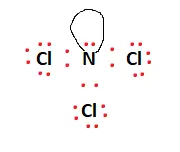
There is a lone pair attached to the Nitrogen atom, and this fulfills the octet requirements of the unabridged molecule. All valence electrons accept been used, and the structural organization is now stable. The final Lewis construction is given below:
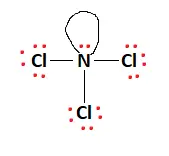
NCl3 Hybridization
Molecular structure and bond formation can be better explained with hybridization in mind. The Hybrid orbitals formed to give a more accurate description of electron regions while also resulting in more stable bonds. An like shooting fish in a barrel way to determine the hybridization of an atom is to calculate the number of electron domains present about it. The bond betwixt atoms (covalent bonds) and Lonely pairs count as electron domains.
In this instance, the Nitrogen atom in Trichloramine forms iii sigma bonds with the surrounding Chlorine atoms. There is also a lone pair fastened to the Nitrogen atom. This gives the Nitrogen atom a steric number of 4, i.e., there are four domains attached to it.
Therefore, the Nitrogen atom at the eye of Trichloramine has an sp3 hybridization.
NCl3 Angles
There are three Chlorine atoms surrounding the primal Nitrogen atoms. This gives it a Trigonal Planar shape. All the same, the presence of a lonely pair changes the shape into a Trigonal Pyramidal one. The bond angles, in this case, are expected to be 109.5°. According to the VSEPR theory (Valence Shell Electron Pair Repulsion Theory), the lone pair on the Nitrogen atom volition repel the atoms around it, pushing it down it further, resulting in bond angles of 107.1°.
NCliii Molecular Geometry and Shape
The Lewis structure of a compound gives insight into its molecular geometry and shape. From the Lewis construction, information technology can be observed that Nitrogen is the fundamental atom while the set of Chlorine atoms nowadays in the molecule surround the Nitrogen atom.
According to the VSEPR theory, electron regions on atoms will repel each other equally much as possible. This repulsion pushes the atoms autonomously to give molecular geometry. The presence of three Chlorine atoms presents a Trigonal Planar shape. However, the alone pair attached to the Nitrogen atom repels the Chlorine atoms to requite a Trigonal Pyramidal structure.
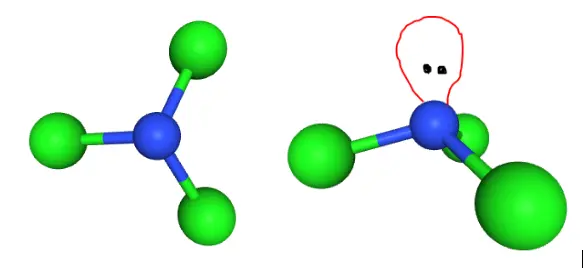
The figures above help visualize the modify in molecular geometry due to repulsion from the alone pair on Nitrogen.
We tin use the A-X-North method to confirm this.
'A' here represents the cardinal Nitrogen cantlet. Therefore, 'A' = 1 in this case.
'X' represents the number of atoms bonded to the central atom. In this example, the Nitrogen atom forms three covalent bonds with the set of surrounding Chlorine atoms.
Therefore, X =iii for the Nitrogen cantlet.
'N' represents the number of solitary pairs attached to the central atom. In this case, N = 1, and a single lone pair of electrons is attached to the central nitrogen atom.
Therefore, that would give us an A-X-N notation of AX3Due north for the Nitrogen atom and the molecule as a whole.
From the A-10-N table below, we tin can determine the molecular geometry for Trichloramine(NClthree).
| Formula | Shape | Bond Bending (Theoretical) |
| AX2 | Linear | 180 |
| AX3 | Trigonal Planar | 120 |
| AX4 | Tetrahedral | 109.v |
| AX5 | Trigonal Bipyrimidal | 120, xc |
| AXhalf-dozen | Octahedral | 90 |
| AXiiN | Aptitude | 120 |
| AXtwoN2 | Bent | 109.5 |
| AX3N | Trigonal Pyramidal | 109.five |
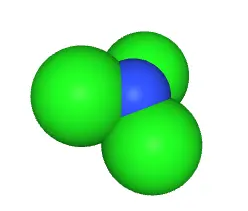
From the above table, it can be observed that an AX3Northward arrangement corresponds to a Trigonal Pyramidal geometry. Therefore, the Trichloramine molecule possesses a Trigonal Pyramidal molecular geometry.
CONCLUDING REMARKS
Let's quickly summarize the salient features of Trichloramine
- Oily, Yellow, and pungent-smelling liquid that is extremely toxic and explosive. Found in swimming pools as a DBP (Disinfection past-production) and can cause irritation and respiratory symptoms.
- NClthree comprises a single, central Nitrogen atom that forms covalent bonds with a prepare of three surrounding Chlorine atoms. There is as well a lone pair attached to the central nitrogen atom.
- The hybridization of the primal Nitrogen in Trichloramine is spthree .
- Trichloramine has a trigonal pyramidal molecular geometry with bond angles of 107.1° due to the presence of a lonely pair at the central Nitrogen atom.

Electron Dot Structure For Ncl3,
Source: https://geometryofmolecules.com/ncl3-lewis-structure-molecular-structure-hybridization-bond-angle-shape/
Posted by: cookplive1938.blogspot.com
0 Response to "Electron Dot Structure For Ncl3"
Post a Comment