

Weight Is Best Described As
| Weight | |
|---|---|
 A spring calibration measures the weight of an object. | |
| Mutual symbols | |
| SI unit | newton (N) |
| Other units | pound-force (lbf) |
| In SI base of operations units | kg⋅m⋅s−ii |
| Extensive? | Yes |
| Intensive? | No |
| Conserved? | No |
| Derivations from | |
| Dimension | |


In science and applied science, the weight of an object is the strength interim on the object due to gravity.[1] [2] [three]
Some standard textbooks[4] define weight as a vector quantity, the gravitational force acting on the object. Others[5] [half-dozen] define weight every bit a scalar quantity, the magnitude of the gravitational forcefulness. Yet others[7] ascertain it as the magnitude of the reaction force exerted on a torso past mechanisms that counteract the effects of gravity: the weight is the quantity that is measured by, for example, a jump scale. Thus, in a state of gratis autumn, the weight would be nothing. In this sense of weight, terrestrial objects can exist weightless: ignoring air resistance, the famous apple tree falling from the tree, on its mode to meet the ground near Isaac Newton, would exist weightless.
The unit for weight is that of strength, which in the International System of Units (SI) is the newton. For example, an object with a mass of one kilogram has a weight of about ix.8 newtons on the surface of the Earth, and about ane-6th as much on the Moon. Although weight and mass are scientifically distinct quantities, the terms are often confused with each other in everyday use (east.k. comparing and converting forcefulness weight in pounds to mass in kilograms and vice versa).[8]
Further complications in elucidating the various concepts of weight accept to do with the theory of relativity according to which gravity is modeled as a result of the curvature of spacetime. In the teaching customs, a considerable debate has existed for over half a century on how to define weight for their students. The current state of affairs is that a multiple gear up of concepts co-be and find use in their various contexts.[2]
History [edit]


Weighing grain, from the Babur-namah[9]
Discussion of the concepts of heaviness (weight) and lightness (levity) appointment dorsum to the ancient Greek philosophers. These were typically viewed as inherent properties of objects. Plato described weight as the natural trend of objects to seek their kin. To Aristotle, weight and levity represented the tendency to restore the natural order of the basic elements: air, earth, burn and water. He ascribed absolute weight to earth and accented levity to fire. Archimedes saw weight as a quality opposed to buoyancy, with the conflict between the two determining if an object sinks or floats. The get-go operational definition of weight was given by Euclid, who defined weight every bit: "the heaviness or lightness of 1 thing, compared to another, as measured past a remainder."[ii] Operational balances (rather than definitions) had, notwithstanding, been around much longer.[10]
According to Aristotle, weight was the straight crusade of the falling motion of an object, the speed of the falling object was supposed to exist direct proportionate to the weight of the object. As medieval scholars discovered that in practice the speed of a falling object increased with time, this prompted a change to the concept of weight to maintain this cause-effect human relationship. Weight was split into a "still weight" or pondus , which remained constant, and the actual gravity or gravitas , which inverse every bit the object savage. The concept of gravitas was somewhen replaced by Jean Buridan'due south impetus, a precursor to momentum.[2]
The rising of the Copernican view of the world led to the resurgence of the Platonic idea that like objects attract but in the context of heavenly bodies. In the 17th century, Galileo made meaning advances in the concept of weight. He proposed a way to measure the deviation between the weight of a moving object and an object at remainder. Ultimately, he concluded weight was proportionate to the amount of matter of an object, not the speed of motion every bit supposed by the Aristotelean view of physics.[2]
Newton [edit]
The introduction of Newton'south laws of move and the development of Newton's law of universal gravitation led to considerable further development of the concept of weight. Weight became fundamentally separate from mass. Mass was identified as a fundamental holding of objects connected to their inertia, while weight became identified with the force of gravity on an object and therefore dependent on the context of the object. In detail, Newton considered weight to exist relative to another object causing the gravitational pull, due east.g. the weight of the Earth towards the Dominicus.[2]
Newton considered time and space to exist accented. This allowed him to consider concepts equally true position and true velocity.[ clarification needed ] Newton also recognized that weight as measured past the action of weighing was afflicted by environmental factors such as buoyancy. He considered this a false weight induced by imperfect measurement atmospheric condition, for which he introduced the term apparent weight as compared to the true weight defined by gravity.[2]
Although Newtonian physics made a clear distinction between weight and mass, the term weight continued to be commonly used when people meant mass. This led the 3rd General Conference on Weights and Measures (CGPM) of 1901 to officially declare "The word weight denotes a quantity of the aforementioned nature equally a force: the weight of a body is the product of its mass and the dispatch due to gravity", thus distinguishing it from mass for official usage.
Relativity [edit]
In the 20th century, the Newtonian concepts of absolute time and space were challenged by relativity. Einstein's equivalence principle put all observers, moving or accelerating, on the same footing. This led to an ambiguity as to what exactly is meant by the force of gravity and weight. A scale in an accelerating elevator cannot be distinguished from a scale in a gravitational field. Gravitational force and weight thereby became essentially frame-dependent quantities. This prompted the abandonment of the concept as superfluous in the fundamental sciences such as physics and chemical science. Nonetheless, the concept remained of import in the teaching of physics. The ambiguities introduced by relativity led, starting in the 1960s, to considerable argue in the didactics community as how to define weight for their students, choosing between a nominal definition of weight every bit the force due to gravity or an operational definition defined past the act of weighing.[two]
Definitions [edit]

This top-fuel dragster can accelerate from zero to 160 kilometres per hr (99 mph) in 0.86 seconds. This is a horizontal dispatch of five.3g. Combined with the vertical g-force in the stationary case the Pythagorean theorem yields a 1000-force of v.4g. It is this m-force that causes the driver's weight if 1 uses the operational definition. If one uses the gravitational definition, the driver's weight is unchanged by the motility of the car.
Several definitions exist for weight, not all of which are equivalent.[3] [eleven] [12] [13]
Gravitational definition [edit]
The most common definition of weight found in introductory physics textbooks defines weight as the forcefulness exerted on a trunk by gravity.[1] [13] This is often expressed in the formula Due west = mg , where W is the weight, one thousand the mass of the object, and 1000 gravitational acceleration.
In 1901, the 3rd General Briefing on Weights and Measures (CGPM) established this as their official definition of weight:
"The word weight denotes a quantity of the aforementioned nature[Note ane] every bit a force: the weight of a trunk is the product of its mass and the dispatch due to gravity."
—Resolution 2 of the tertiary General Briefing on Weights and Measures[15] [sixteen]
This resolution defines weight equally a vector, since force is a vector quantity. Nevertheless, some textbooks besides take weight to be a scalar by defining:
"The weight W of a body is equal to the magnitude Fg of the gravitational force on the torso."[17]
The gravitational dispatch varies from place to place. Sometimes, it is simply taken to accept a standard value of ix.80665 thousand/stwo , which gives the standard weight.[fifteen]
The force whose magnitude is equal to mg newtons is as well known every bit the m kilogram weight (which term is abbreviated to kg-wt)[eighteen]
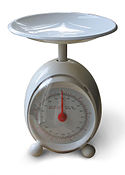
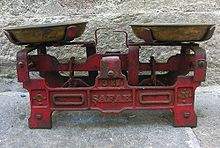
Left: A leap scale measures weight, by seeing how much the object pushes on a spring (inside the device). On the Moon, an object would give a lower reading. Right: A balance calibration indirectly measures mass, by comparison an object to references. On the Moon, an object would requite the same reading, because the object and references would both go lighter.
Operational definition [edit]
In the operational definition, the weight of an object is the force measured by the operation of weighing information technology, which is the forcefulness it exerts on its back up.[11] Since Westward is the downwards forcefulness on the body by the centre of earth and in that location is no acceleration in the body, there exists an opposite and equal strength by the support on the torso. Besides it is equal to the force exerted by the body on its support because activeness and reaction have same numerical value and opposite direction. This can brand a considerable difference, depending on the details; for example, an object in costless autumn exerts little if any force on its back up, a situation that is commonly referred to as weightlessness. However, beingness in free autumn does not touch the weight according to the gravitational definition. Therefore, the operational definition is sometimes refined past requiring that the object be at residual.[ commendation needed ] However, this raises the issue of defining "at balance" (unremarkably being at remainder with respect to the Earth is implied by using standard gravity).[ citation needed ] In the operational definition, the weight of an object at rest on the surface of the World is lessened by the outcome of the centrifugal force from the Earth's rotation.
The operational definition, equally unremarkably given, does not explicitly exclude the furnishings of buoyancy, which reduces the measured weight of an object when information technology is immersed in a fluid such as air or water. As a result, a floating balloon or an object floating in water might be said to have zero weight.
ISO definition [edit]
In the ISO International standard ISO 80000-iv:2006,[19] describing the basic concrete quantities and units in mechanics as a part of the International standard ISO/IEC 80000, the definition of weight is given as:
Definition
- ,
- where m is mass and g is local acceleration of free fall.
Remarks
- When the reference frame is Earth, this quantity comprises non only the local gravitational force, but also the local centrifugal strength due to the rotation of the World, a force which varies with latitude.
- The issue of atmospheric buoyancy is excluded in the weight.
- In common parlance, the proper noun "weight" continues to be used where "mass" is meant, but this practice is deprecated.
—ISO 80000-iv (2006)

The definition is dependent on the chosen frame of reference. When the called frame is co-moving with the object in question then this definition precisely agrees with the operational definition.[12] If the specified frame is the surface of the Earth, the weight according to the ISO and gravitational definitions differ only by the centrifugal effects due to the rotation of the Earth.
Apparent weight [edit]
In many existent world situations the human activity of weighing may produce a upshot that differs from the ideal value provided by the definition used. This is usually referred to every bit the apparent weight of the object. A common example of this is the upshot of buoyancy, when an object is immersed in a fluid the displacement of the fluid will crusade an upward force on the object, making information technology appear lighter when weighed on a scale.[20] The apparent weight may exist similarly affected by levitation and mechanical break. When the gravitational definition of weight is used, the operational weight measured by an accelerating scale is ofttimes also referred to as the credible weight.[21]
Mass [edit]
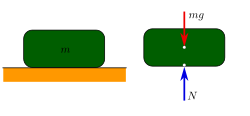
An object with mass grand resting on a surface and the corresponding free body diagram of just the object showing the forces acting on information technology. Notice that the amount of force that the table is pushing upwards on the object (the N vector) is equal to the downward force of the object'southward weight (shown hither as mg, as weight is equal to the object's mass multiplied with the acceleration due to gravity): because these forces are equal, the object is in a state of equilibrium (all the forces and moments interim on it sum to zero).
In mod scientific usage, weight and mass are fundamentally different quantities: mass is an intrinsic property of affair, whereas weight is a forcefulness that results from the action of gravity on affair: it measures how strongly the force of gravity pulls on that thing. Still, in almost practical everyday situations the word "weight" is used when, strictly, "mass" is meant.[8] [22] For case, most people would say that an object "weighs one kilogram", even though the kilogram is a unit of mass.
The distinction between mass and weight is unimportant for many practical purposes because the forcefulness of gravity does not vary likewise much on the surface of the Globe. In a uniform gravitational field, the gravitational force exerted on an object (its weight) is directly proportional to its mass. For instance, object A weighs ten times every bit much every bit object B, so therefore the mass of object A is 10 times greater than that of object B. This means that an object'southward mass can exist measured indirectly past its weight, and so, for everyday purposes, weighing (using a weighing scale) is an entirely acceptable way of measuring mass. Similarly, a balance measures mass indirectly by comparing the weight of the measured detail to that of an object(s) of known mass. Since the measured item and the comparison mass are in virtually the aforementioned location, and then experiencing the same gravitational field, the effect of varying gravity does not affect the comparison or the resulting measurement.
The Globe's gravitational field is not uniform merely can vary by as much as 0.five%[23] at unlike locations on Earth (see Globe'southward gravity). These variations alter the relationship between weight and mass, and must be taken into account in high-precision weight measurements that are intended to indirectly measure mass. Leap scales, which measure local weight, must be calibrated at the location at which the objects will be used to show this standard weight, to be legal for commerce.[ commendation needed ]
This table shows the variation of dispatch due to gravity (and hence the variation of weight) at diverse locations on the Earth's surface.[24]
| Location | Latitude | m/southward2 | Accented difference from equator | Percentage difference from equator |
|---|---|---|---|---|
| Equator | 0° | ix.7803 | 0.0000 | 0% |
| Sydney | 33°52′ S | nine.7968 | 0.0165 | 0.17% |
| Aberdeen | 57°nine′ Due north | 9.8168 | 0.0365 | 0.37% |
| N Pole | 90° N | 9.8322 | 0.0519 | 0.53% |
The historical employ of "weight" for "mass" as well persists in some scientific terminology – for example, the chemic terms "atomic weight", "molecular weight", and "formula weight", can withal be plant rather than the preferred "atomic mass", etc.
In a different gravitational field, for example, on the surface of the Moon, an object can accept a significantly dissimilar weight than on Earth. The gravity on the surface of the Moon is but about 1-sixth as strong as on the surface of the World. A i-kilogram mass is still a one-kilogram mass (as mass is an intrinsic property of the object) but the downward force due to gravity, and therefore its weight, is only ane-sixth of what the object would have on World. So a man of mass 180 pounds weighs but about xxx pounds-force when visiting the Moon.
SI units [edit]
In most mod scientific work, concrete quantities are measured in SI units. The SI unit of weight is the same as that of strength: the newton (N) – a derived unit of measurement which can also be expressed in SI base units as kg⋅grand/south2 (kilograms times metres per second squared).[22]
In commercial and everyday utilize, the term "weight" is usually used to hateful mass, and the verb "to weigh" means "to determine the mass of" or "to have a mass of". Used in this sense, the proper SI unit is the kilogram (kg).[22]
As of 20 May 2019, the kilogram, which is essential to evaluate the weight of an object, has been redefined in terms of Planck's constant. The new definition does not affect the actual amount of the material but increases the measurement's quality and decreases the uncertainty associated with it.[25] Prior to using Planck'due south abiding, a physical object was used as a standard. The object, located in a vault in Sèvres, France, has fluctuated by approximately 50 micrograms of its mass since it was first introduced in 1889.[26] Consequently, the following must be true. Mass, which should exist the same whether on earth or the moon for example, is only valid on earth since it needs to be referenced. Also, comparison a weight measurement to a standard that changes with fourth dimension cannot be used every bit a reference without citing the bodily value of it at the time and moment it was used every bit such. Therefore, to redefine the kilogram all National Metrology Institutes (NMIs) involved determined the new value of Planck's constant past evaluating a mass which was calibrated against the IPK.[27] To this extent 1 kilogram is equal to h/(6.62607015×x^(-34) ) thousand^(-2) s which equals 1 m^(-2) due south. A kilogram has remained the same quantity it was before the redefinition.[27] Only equally of May 2019, the weights measured and recorded can exist traced back and used every bit comparison for current and hereafter work.
Pound and other not-SI units [edit]
In United States customary units, the pound can exist either a unit of force or a unit of mass.[28] Related units used in some distinct, split up subsystems of units include the poundal and the slug. The poundal is defined as the forcefulness necessary to accelerate an object of one-pound mass at 1ft/due south2, and is equivalent to nearly 1/32.two of a pound-force. The slug is defined as the amount of mass that accelerates at 1ft/stwo when ane pound-force is exerted on it, and is equivalent to about 32.2 pounds (mass).
The kilogram-force is a non-SI unit of force, defined as the strength exerted by a 1-kilogram mass in standard Earth gravity (equal to 9.80665 newtons exactly). The dyne is the cgs unit of forcefulness and is not a office of SI, while weights measured in the cgs unit of mass, the gram, remain a function of SI.
Sensation [edit]
The sensation of weight is caused by the force exerted by fluids in the vestibular organization, a three-dimensional set of tubes in the inner ear.[ dubious ] Information technology is actually the awareness of grand-strength, regardless of whether this is due to being stationary in the presence of gravity, or, if the person is in motion, the result of any other forces interim on the body such as in the case of acceleration or deceleration of a lift, or centrifugal forces when turning sharply.
Measuring [edit]
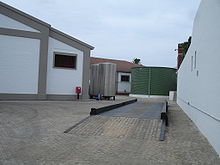
Weight is commonly measured using one of two methods. A leap scale or hydraulic or pneumatic scale measures local weight, the local force of gravity on the object (strictly credible weight force). Since the local force of gravity can vary by up to 0.5% at different locations, spring scales will measure slightly different weights for the same object (the same mass) at different locations. To standardize weights, scales are always calibrated to read the weight an object would have at a nominal standard gravity of 9.80665one thousand/sii (approx. 32.174ft/s2). However, this calibration is done at the factory. When the scale is moved to some other location on World, the force of gravity will be different, causing a slight error. And then to be highly authentic and legal for commerce, spring scales must be re-calibrated at the location at which they will exist used.
A balance on the other hand, compares the weight of an unknown object in ane calibration pan to the weight of standard masses in the other, using a lever mechanism – a lever-balance. The standard masses are often referred to, not-technically, every bit "weights". Since whatever variations in gravity will human action equally on the unknown and the known weights, a lever-residual volition bespeak the aforementioned value at whatever location on Earth. Therefore, remainder "weights" are usually calibrated and marked in mass units, and then the lever-rest measures mass by comparing the Earth's attraction on the unknown object and standard masses in the scale pans. In the absence of a gravitational field, abroad from planetary bodies (e.yard. space), a lever-balance would not piece of work, but on the Moon, for case, information technology would give the same reading every bit on Earth. Some balances are marked in weight units, but since the weights are calibrated at the factory for standard gravity, the balance will mensurate standard weight, i.e. what the object would weigh at standard gravity, not the actual local forcefulness of gravity on the object.
If the actual force of gravity on the object is needed, this can exist calculated by multiplying the mass measured by the residual by the acceleration due to gravity – either standard gravity (for everyday work) or the precise local gravity (for precision work). Tables of the gravitational acceleration at different locations tin be found on the web.
Gross weight is a term that is more often than not found in commerce or trade applications, and refers to the full weight of a production and its packaging. Conversely, cyberspace weight refers to the weight of the product alone, discounting the weight of its container or packaging; and tare weight is the weight of the packaging solitary.
Relative weights on the Earth and other angelic bodies [edit]
The table beneath shows comparative gravitational accelerations at the surface of the Sunday, the World'southward moon, each of the planets in the solar system. The "surface" is taken to mean the cloud tops of the gas giants (Jupiter, Saturn, Uranus and Neptune). For the Lord's day, the surface is taken to hateful the photosphere. The values in the table have not been de-rated for the centrifugal outcome of planet rotation (and cloud-height current of air speeds for the gas giants) and therefore, generally speaking, are like to the actual gravity that would exist experienced near the poles.
| Body | Multiple of Earth gravity | Surface gravity m/southward2 |
|---|---|---|
| Sun | 27.90 | 274.i |
| Mercury | 0.3770 | 3.703 |
| Venus | 0.9032 | 8.872 |
| Earth | i (by definition) | 9.8226 [29] |
| Moon | 0.1655 | 1.625 |
| Mars | 0.3895 | 3.728 |
| Jupiter | 2.640 | 25.93 |
| Saturn | 1.139 | 11.xix |
| Uranus | 0.917 | nine.01 |
| Neptune | one.148 | 11.28 |
See also [edit]
- Homo body weight – Person's mass or weight
- Tare weight
- weight – Unit of measurement of weight the English unit
Notes [edit]
- ^ The phrase "quantity of the aforementioned nature" is a literal translation of the French phrase grandeur de la même nature. Although this is an authorized translation, VIM iii of the International Bureau of Weights and Measures recommends translating grandeurs de même nature as quantities of the same kind.[14]
References [edit]
- ^ a b Richard C. Morrison (1999). "Weight and gravity - the need for consequent definitions". The Physics Teacher. 37 (1): 51. Bibcode:1999PhTea..37...51M. doi:ten.1119/1.880152.
- ^ a b c d e f m h Igal Galili (2001). "Weight versus gravitational force: historical and educational perspectives". International Journal of Science Educational activity. 23 (10): 1073. Bibcode:2001IJSEd..23.1073G. doi:x.1080/09500690110038585. S2CID 11110675.
- ^ a b Gat, Uri (1988). "The weight of mass and the mess of weight". In Richard Alan Strehlow (ed.). Standardization of Technical Terminology: Principles and Practice – second volume . ASTM International. pp. 45–48. ISBN978-0-8031-1183-7.
- ^ Knight, Randall D. (2004). Physics for Scientists and Engineers: a Strategic Approach. San Francisco, USA: Addison–Wesley. pp. 100–101. ISBN0-8053-8960-one.
- ^ Bauer, Wolfgang and Westfall, Gary D. (2011). University Physics with Modern Physics. New York: McGraw Hill. p. 103. ISBN978-0-07-336794-1.
{{cite book}}: CS1 maint: multiple names: authors list (link) - ^ Serway, Raymond A. and Jewett, John W. Jr. (2008). Physics for Scientists and Engineers with Mod Physics. USA: Thompson. p. 106. ISBN978-0-495-11245-7.
{{cite book}}: CS1 maint: multiple names: authors listing (link) - ^ Hewitt, Paul M. (2001). Conceptual Physics. USA: Addison–Wesley. pp. 159. ISBN0-321-05202-1.
- ^ a b The National Standard of Canada, CAN/CSA-Z234.1-89 Canadian Metric Exercise Guide, January 1989:
- five.7.3 Considerable confusion exists in the employ of the term "weight". In commercial and everyday employ, the term "weight" nearly ever means mass. In science and technology "weight" has primarily meant a forcefulness due to gravity. In scientific and technical work, the term "weight" should be replaced by the term "mass" or "force", depending on the application.
- five.7.iv The apply of the verb "to weigh" meaning "to determine the mass of", e.k., "I weighed this object and determined its mass to be vkg," is correct.
- ^ Sur Das (1590s). "Weighing Grain". Baburnama.
- ^ http://www.averyweigh-tronix.com/museum Archived 2013-02-28 at the Wayback Machine accessed 29 March 2013.
- ^ a b Allen L. King (1963). "Weight and weightlessness". American Journal of Physics. 30 (5): 387. Bibcode:1962AmJPh..30..387K. doi:10.1119/1.1942032.
- ^ a b A. P. French (1995). "On weightlessness". American Periodical of Physics. 63 (2): 105–106. Bibcode:1995AmJPh..63..105F. doi:10.1119/ane.17990.
- ^ a b Galili, I.; Lehavi, Y. (2003). "The importance of weightlessness and tides in educational activity gravitation" (PDF). American Periodical of Physics. 71 (11): 1127–1135. Bibcode:2003AmJPh..71.1127G. doi:10.1119/1.1607336.
- ^ Working Group 2 of the Articulation Committee for Guides in Metrology (JCGM/WG two) (2008). International vocabulary of metrology – Bones and general concepts and associated terms (VIM) – Vocabulaire international de métrologie – Concepts fondamentaux et généraux et termes associés (VIM) (PDF) (JCGM 200:2008) (in English language and French) (third ed.). BIPM. Annotation 3 to Department i.2.
- ^ a b "Resolution of the 3rd meeting of the CGPM (1901)". BIPM.
- ^ David B. Newell; Eite Tiesinga, eds. (2019). The International Arrangement of Units (SI) (PDF) (NIST Special publication 330, 2019 ed.). Gaithersburg, Dr.: NIST. p. 46.
- ^ Halliday, David; Resnick, Robert; Walker, Jearl (2007). Fundamentals of Physics. Vol. one (eighth ed.). Wiley. p. 95. ISBN978-0-470-04473-5.
- ^ Chester, W. Mechanics. George Allen & Unwin. London. 1979. ISBN 0-04-510059-4. Section three.2 at folio 83.
- ^ ISO 80000-4:2006, Quantities and units - Part 4: Mechanics
- ^ Bong, F. (1998). Principles of mechanics and biomechanics. Stanley Thornes Ltd. pp. 174–176. ISBN978-0-7487-3332-3.
- ^ Galili, Igal (1993). "Weight and gravity: teachers' ambivalence and students' confusion about the concepts". International Journal of Scientific discipline Instruction. 15 (2): 149–162. Bibcode:1993IJSEd..15..149G. doi:x.1080/0950069930150204.
- ^ a b c A. Thompson & B. Northward. Taylor (March 3, 2010) [July 2, 2009]. "The NIST Guide for the employ of the International Arrangement of Units, Section eight: Comments on Some Quantities and Their Units". Special Publication 811. NIST. Retrieved 2010-05-22 .
- ^ Hodgeman, Charles, ed. (1961). Handbook of Chemical science and Physics (44th ed.). Cleveland, United states: Chemical Safety Publishing Co. pp. 3480–3485.
- ^ Clark, John B (1964). Concrete and Mathematical Tables. Oliver and Boyd.
- ^ Yadav, Southward., & Aswal, D. K. (2020, February 25). Redefined SI Units and Their Implications. Mapan, pp. 1-9.
- ^ Jeffrey-Wilensky, J. (2019, May xx). The definition of the kilogram only changed. Here's what that means. Retrieved from NBC News: https://www.nbcnews.com/mach/science/definition-kilogram-just-changed-hither-s-what-ways-ncna1007731
- ^ a b Ehtesham, B., John, T., Yadav, S., Singh, H. Chiliad., Mandal, G., & Singh, N. (2020). Journey of Kilogram from Physical Constant to Universal Physical Constant (h) via Artefact: A Brief Review. MAPAN - Journal of Metrology Society of Bharat, 1-9
- ^ "Common Conversion Factors, Gauge Conversions from U.South. Customary Measures to Metric". Nist. National Establish of Standards and Engineering science. 13 Jan 2010. Retrieved 2013-09-03 .
- ^ This value excludes the aligning for centrifugal force due to Earth's rotation and is therefore greater than the 9.80665m/stwo value of standard gravity.

Weight Is Best Described As,
Source: https://en.wikipedia.org/wiki/Weight
Posted by: cookplive1938.blogspot.com
0 Response to "Weight Is Best Described As"
Post a Comment