

Altitude And Golf Ball Distance
Golf game Brawl Aerodynamics and the Consequence of Altitude
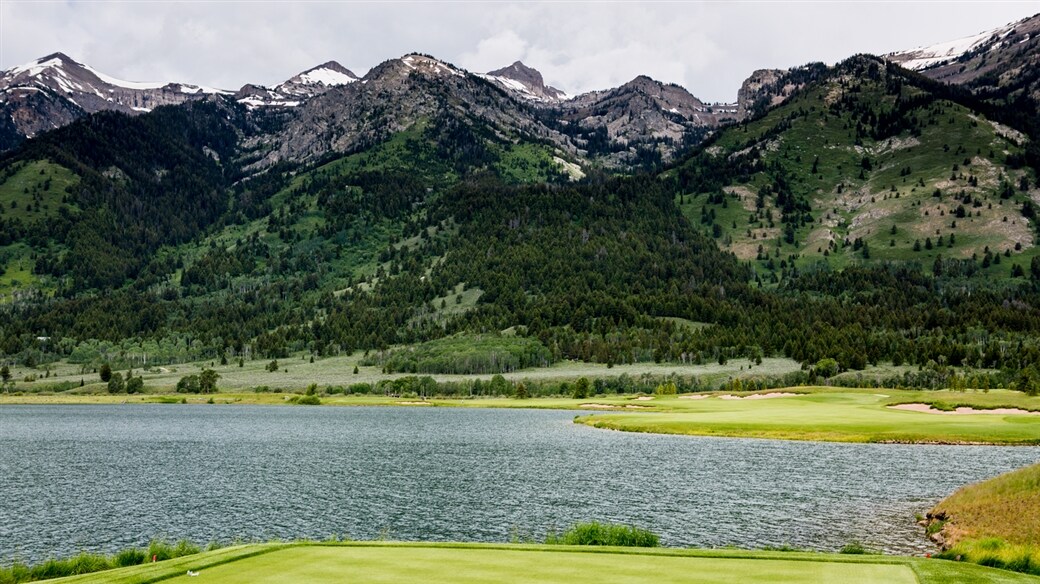
If you lot've ever played golf game on higher distance courses like ones in Denver, Jackson Pigsty or Reno, y'all probably noticed that you were seeing some added altitude to your game. And if you wanted to know the how and the why your golf game ball seems to wing so far at high altitudes, we've got the answers.
We called on one of our experts, Steven Aoyama, who is a Main Scientist hither in Titleist Golf Ball R&D to shed some light on this topic. Steve has conducted all-encompassing enquiry on the effects of altitude, temperature and humidity on golf game ball performance and he was kind enough to share some findings with us.
 Steve Aoyama
Golf Ball Flight at Altitude: Chief Takeaways:
- The golf brawl flies farther in high altitudes mainly due to the change in air density, which decreases as elevation increases. Thinner air exerts less drag force on the ball. The ball moves more than easily through the air and doesn't slow downward equally rapidly as it flies, resulting in greater altitude.
- The force of gravity likewise decreases the further we move abroad from the globe's eye, but the change in strength is also modest to accept whatever significant effect on the ball.
- Y'all can calculate the distance proceeds you volition feel (compared to sea level) by multiplying the meridian (in feet) past .00116. For case, if you're playing in Reno, at 1 mile elevation (five,280 ft.) the increase is virtually 6% (5,280 10 .00116 = six.1248). If you lot unremarkably drive the brawl 250 yards at bounding main level, you volition probable drive it 265 yards in Reno.
- The golf ball does not spin whatsoever less at high superlative. Still, because the air is less dense and imparts less force on the ball, the lift forcefulness is also lower. You'll run across a flatter trajectory on your longer shots, a more than shallow angle of descent and greater roll.
- Because the air is less dumbo at college altitudes and imparts less forcefulness on the golf ball, the ball won't slice or hook as much. It volition exist harder to shape shots.
- The shorter the shot and the slower a ball moves through the air, the altitude will have a lesser effect on golf game ball aerodynamics. This ways, on short approaches and greenside shots, you lot don't accept to arrange for peak.
• • •
To acquire more about golf game brawl aerodynamics, check out our video above — Learning to Fly: Dimples and Golf Brawl Design .
• • •
Golf Brawl Scientific discipline: How Does Altitude Affect Golf Balls?
It is commonly believed that golf balls fly further at college elevations, and in that location is a skillful reason for that: it's mostly true. Various explanations for this have been asserted over the years, normally related to thin air or reduced gravity.
The notion of reduced gravity at higher elevations is technically true, because the forcefulness of gravity decreases with increased distance from the middle of the Earth. When playing golf in Denver, for example, we are well-nigh a mile further from the middle of the Globe than we are when playing in Los Angeles. Even so, that results in merely a tiny reduction in gravity. Fifty-fifty on the top of Mount Everest the gravity is but reduced by about 1/4 of one percent. At that place are greater variations (around 1/2 percent) due to factors such as breadth or local variations in the Earth'due south makeup, and nobody worries almost that.
Air density, on the other hand, can make a divergence that is worth consideration. At higher elevations, the air is less dumbo ("thinner"). A golf ball (or an airplane, or a car, or anything else for that matter) has an easier time pushing through information technology. Thus, information technology doesn't ho-hum down as quickly as it flies, resulting in greater altitude. Since golf game shots vary widely in their launch weather condition (the initial speed, spin rate, and launch angle of the ball), the effect will vary profoundly depending on the golfer and what guild is being used.
However, as a starting point, one tin estimate the percent altitude increase (compared to sea level) by multiplying the summit (in anxiety) by .00116. For instance, at 5,000 ft elevation the increase is almost v,000 x .00116 = five.8%. Thus, a golfer who drives the brawl 250 yards in LA might come across an increase of 14.5 yards (5.eight% of 250) when playing in Denver (264.5 yards). The percent increase volition be less for players with slower swing speeds and/or when hitting a shorter shot. Just on a mid to long approach shot, that could nevertheless make a one club difference. Not to mention that you lot'll be about a social club closer to the green as a result of the longer drive.
Golf Ball Spin at High Altitudes
It is also sometimes said that the ball spins less at higher elevations. This is simulated. The amount of spin generated on a given shot is the issue of a complicated physical interaction amidst the club's properties, the brawl's backdrop, and the golfer'southward swing properties. These aren't going to exist directly affected past meridian.
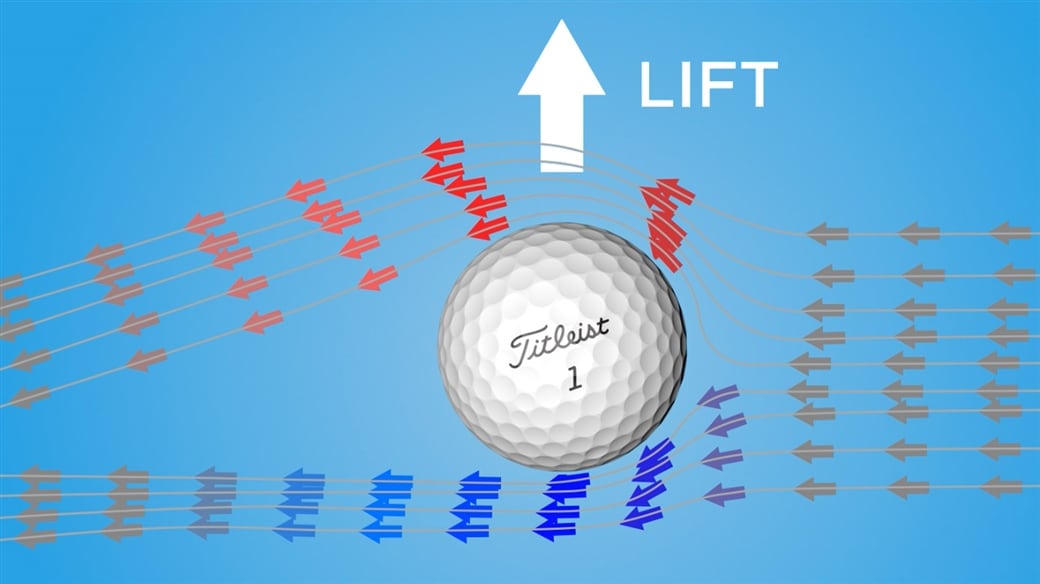
On the other manus, it's easy to see why many golfers believe that the ball spins less. Since the air is less dense at high altitudes, the spin has less issue on the ball's flight. The ball's spin generates a lifting force (like the wings of an aeroplane) every bit information technology moves through the air. The thinner the air, the smaller the lifting force. Thus, at higher elevations the trajectory is less influenced by lift, and thus has a "flatter" shape and a more glancing impact with the footing. This produces extra curl, which contributes to the increased distance but besides makes it harder to hold the light-green, fifty-fifty though the spin is the same.
The Result of Altitude on Hooking and Slicing
Hooking and slicing are reduced in severity due to altitude's effect on the golf game brawl. A hook or slice is generated when the ball's spin axis is tilted and the lifting force pulls a piffling to the left or correct (as a result of the golfer imparting some corporeality of sidespin to the ball) instead of straight upwards. Thus, instead of merely property the ball up confronting gravity, the lifting force too pulls to the side, creating the curved trajectory. If the lifting forcefulness is less due to lower air density, then the curvature will too be less. At 5,000 ft elevation, the air density is nearly xiv% lower than at ocean level, and so the lifting force is also about 14% less and the claw or slice volition bend about 14% less. It's easier to striking the brawl direct, simply information technology's harder to intentionally bend information technology.
Short Shots at High Distance
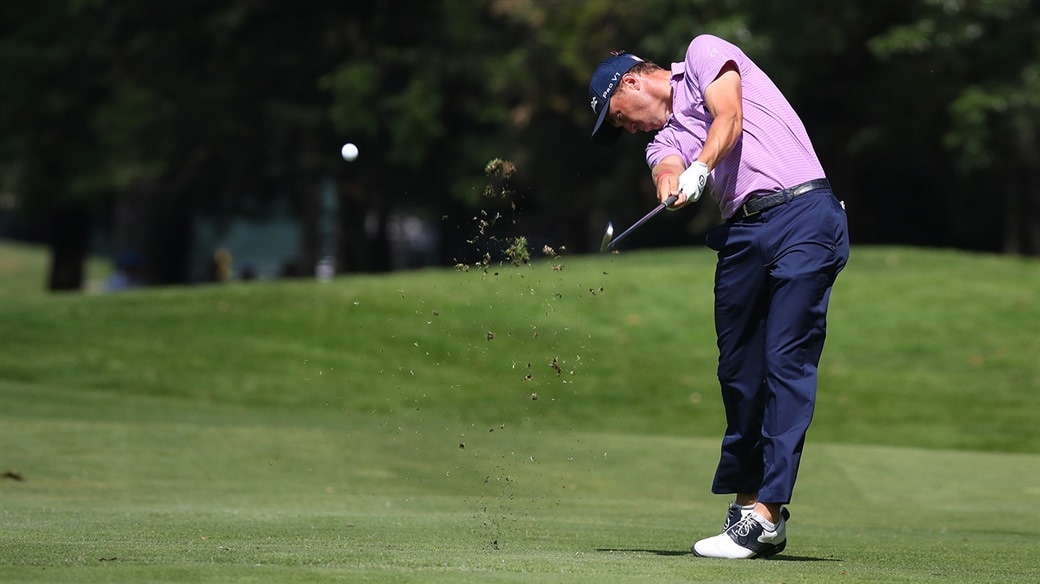
Everything stated higher up becomes less important as shots get shorter. The shorter the shot, the slower it'due south moving through the air, and the less effect is felt from anything aerodynamic. Thus, on short approaches and especially on greenside shots, elevation is not something to worry about since it will not touch the golf ball'south altitude.
Give thanks for the insight, Steve!
• • •
Editor's Note: This commodity originally appeared on March 2, 2017.
#TeamTitleist

Altitude And Golf Ball Distance,
Source: https://www.titleist.ca/teamtitleist/b/tourblog/posts/the-effect-of-altitude-golf-ball-aerodynamics
Posted by: cookplive1938.blogspot.com
0 Response to "Altitude And Golf Ball Distance"
Post a Comment