

2010 Mustang Gt 0 60
| Ford Mustang | |
|---|---|
 Ford Mustang GT (2005–2009) | |
| Overview | |
| Manufacturer | Ford |
| Product | September 2004 – June 2014 |
| Model years | 2005–2014 |
| Associates | United states: Flat Rock, Michigan (Flat Rock Assembly Plant) |
| Designer | Sid Ramnarace (2001, 2002) |
| Body and chassis | |
| Body mode | 2-door Convertible 2-door Coupe |
| Layout | FR layout |
| Platform | Ford D2C platform |
| Related | Lincoln LS[i] Ford Thunderbird (eleventh generation) Jaguar Southward-Type/XF |
| Chronology | |
| Predecessor | Ford Mustang (fourth generation) |
| Successor | Ford Mustang (sixth generation) |
The fifth-generation Ford Mustang (S197) is a pony car that was manufactured by Ford from 2004 to 2014, at the Flat Rock Assembly Plant in Flat Rock, Michigan. The 5th generation began with the 2005 model year, and received a facelift for the 2010 model year. Originally designed past Sid Ramnarace through late 2001 and finalized in mid-2002, the fifth-generation Mustang's blueprint was previewed by two pre production concept cars that debuted at the 2003 North American International Motorcar Bear witness. Development began on the South-197 programme in 1999 under principal engineer Hau Thai-Tang, presently after the 1998 launch of "New Edge" SN-95 facelift. From the second half of 1999, blueprint work commenced under Ford design chief, J Mays, and concluded in July 2002 with the design freeze.[ii] [iii] There have been several variants of the fifth-generation Ford Mustang that include the Mustang GT/California Special, Shelby Mustang, Bullitt Mustang, and Boss 302 Mustang.
Pre-production concepts [edit]
2003 Ford Mustang GT Concept, 2003 Mustang Convertible Concept [edit]
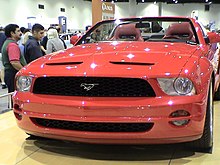
The fifth-generation Mustang convertible concept, which resembles the later Shelby GT500
Adult betwixt February and November 2002, 2 pre-product concept cars, a convertible and coupe model, were presented past Ford at the 2003 North American International Auto Show on January 5, 2003.[iv] [5] [6]
The Redline Red Metallic Ford Mustang GT convertible concept included a "showbar" with a rim of billet-aluminum trim, twenty-inch wheels, 13.8-in cross-drilled Brembo brakes, ruddy and charcoal leather upholstery with perforated surfaces on the seat backs, billet-aluminum shifter for the v-speed automatic transmission, too as four-bespeak racing-mode seatbelts and instrument gauges.[7]
The Tungsten Argent Ford Mustang GT coupe concept included a glass roof and functional hood scoops, too as a red and charcoal leather interior accented by billet-aluminum hardware and a supercharged Mod 4.6 L engine rated well-nigh 400 horsepower.[8]
Appearing with other concept vehicles at the prove such as the Cadillac Sixteen, Aston Martin V8 Vantage, and Contrivance Tomahawk, AutoWeek called the Mustang concept the "nigh significant vehicle in evidence".[9]
Both vehicles were somewhen sold at the 2009 Barrett-Jackson Palm Beach sale for $175,000 each (earlier heir-apparent premium).
Southward-197 concept [edit]
At the following twelvemonth'due south North American International Auto Show, Ford introduced a redesigned Mustang previewed by the 2003 concept vehicle that was codenamed "Due south-197". Its platform was the D2C for the 2005 model year. Developed nether the direction of Chief Engineer Hau Thai-Tang and exterior styling designer Sid Ramnarace, the 5th generation Mustang drew inspiration from the outset-generation 1964–1970 Mustangs.[10] [11] The design artful of J Mays, Ford's Senior Vice President of Design, has been described as "retro-futurism."[12]
Initial release [edit]
Mustang [edit]
| 2005–2009 Mustang S-197 | |
|---|---|
 | |
| Overview | |
| Production | September 2004 – December 2008 |
| Model years | 2005–2009 |
| Designer | Doug Gaffka (S-197 design chief: 2000–2001) Larry Erickson (S-197 blueprint chief 2001–2004) Sid Ramnarace (S-197 exterior: 2001) Kevin George (Southward-197 interior: 2001) Doug Gaffka (Bullitt: 2006)[13] |
| Powertrain | |
| Engine | four.0 L (245 CID) Cologne V6 iv.6 L (281 CID) Modular V8 5.4 L (330 CID) Modular Supercharged V8 |
| Transmission | 5-speed manual (T-5, TR-3650) 6-speed transmission (TR-6060) five-speed automated (5R55S) |
| Dimensions | |
| Wheelbase | 107.1 in (two,720 mm) |
| Length | 187.6 in (4,770 mm) |
| Width | 73.8 in (one,870 mm) |
| Height | 54.5 in (ane,380 mm) |
| Curb weight | V6 coupe MT/AT: iii,350 lb (1,520 kg)/3,420 lb (1,551 kg) V6 convertible MT/AT: iii,475 lb (one,576 kg)/3,555 lb (1,613 kg) V8 coupe MT/AT: three,480 lb (1,579 kg)/3,525 lb (one,599 kg) V8 convertible MT/AT: 3,610 lb (1,637 kg)/iii,655 lb (one,658 kg) GT500 coupe: iii,950 lb (1,792 kg) GT500 convertible: 4,040 lb (one,833 kg) |
| Chronology | |
| Predecessor | 1999–2004 Mustang (SN-95 II) |
| Successor | 2010–2014 Mustang (S-197 Ii) |

2005–2009 Ford Mustang V6 convertible

2005–2009 Ford Mustang V6 convertible
Production start-up for the 2005 Mustang was on September 7, 2004, with the first 2005 model rolling off Flat Rock Assembly on September 27, 2004. U.S. market launch and client delivery began at the end of October 2004, with production ending in late 2008 for the 2009 model.
The 2005–2009 base Mustang was powered by Ford's bandage iron cake four.0 L Cologne SOHC V6, replacing the three.eight L Essex OHV V6 used in 2004 and older models. It produces 210 hp (157 kW) at 5300 rpm and 240 lb⋅ft (325 North⋅1000) of torque at 3500 rpm and was mated to a standard Tremec T-5 v-speed manual transmission with Ford's 5R55S v-speed automated transmission available every bit an option. A 3.31:i terminal drive ratio is standard with either manual. In a comparing test with a Pontiac G6 Convertible conducted past Motor Trend mag, a Mustang V6 convertible equipped with an automatic transmission was able to accelerate from cypher to threescore mph (97 km/h) in 7.3 seconds; 1.iv seconds better than the 2006 Pontiac G6 convertible.[14] [15]
The Mustang has a MacPherson strut front suspension with reverse "L" lower control arms. The rear suspension was a new iii-link organisation with a Panhard Rod that controls the vertical and lateral movements of the axle.[16] This alive axle rear suspension, while sacrificing handling, provides the benefits of reduced cost and weight over heavier, more than expensive independent rear suspensions. In spite of this, Ford has drawn heavy criticism from the automotive journalism customs for the decision to equip the fifth generation Mustang with the live axle organization. At a printing conference, Ford stated that to include an independent rear suspension would accept added $5,000 to the exhibit price of the car.
Standard equipment on the 2005 Mustang includes ability windows, dual power mirrors, power door locks with remote keyless entry, front air bags, AM/FM stereo with CD actor, 16-inch painted aluminum wheels, and larger restriction discs than the previous generation Mustang with twin-piston calipers in the front. Some of the options available included Ford'due south MyColor (a color-configurable instrument cluster bachelor as office of the Interior Upgrade Bundle), brushed aluminum panels (also office of the Interior Upgrade Package), Ford's Shaker 500 (500 watt tiptop output) or Shaker m (grand watt peak output) premium sound system with a 6-disc MP3-compatible CD changer, leather seating surfaces, a six-way ability adjustable driver seat, and a 4-aqueduct anti-lock restriction organization with traction control (standard on GT models).[17] All Mustang GT and Convertibles came with a rear sway bar with white links during these years; the bar bore varied with options and was eighteen mm, 19 mm, 20 mm, or 22.4 mm. Replacement links from Ford are colored black or oxide coated [18]
For 2006, a less expensive version of the Mustang was introduced every bit the new base of operations model. Slotted below the V6 Deluxe, the V6 Standard, starting at $xix,115 MSRP for a Coupe, or $23,940 MSRP for a Convertible, the V6 Standard models were each $100 less expensive than their V6 Deluxe counterparts. The merely difference betwixt the V6 Standard and V6 Deluxe trim levels was that the V6 Standard featured sixteen-inch black steel wheels with plastic bicycle covers, versus the sixteen-inch alloy wheels on the V6 Palatial. However, sixteen-inch alloy wheels could still be optioned on the V6 Standard, as could most other available options on the V6 Palatial. The V6 Standard was discontinued after the 2006 model year, once more leaving the V6 Palatial every bit the base of operations Mustang trim level.
As of 2007, all 2008 Mustangs have seats containing material derived from soy beans,[nineteen] harking back to some of Henry Ford's ideals.
Ford Sync was available on the 2009 model only every bit a dealer-installed kit.
Several new options and standard features were introduced in the following years, including the Pony Packet (2006), a DVD-based GPS navigation system fabricated by Pioneer (2007), a ability passenger seat (2007), heated seats (2007), Sirius Satellite Radio (2007), new flat bottom spoiler for V6 just (2006), standard side airbags (2006), HID headlamps (2008), and ambient interior lighting (2006). The ambience interior lighting parcel consisted of the installation of electroluminescence that gave the driver the ability to choose various color combinations for the instrument cluster, sound system and climate control displays, besides as light emitting from the pinnacle of the front footwells and from beneath the rear seats.
For 2009, Ford introduced a new option called the glass roof. This option ($one,995 at introduction) was in consequence a full roof sunroof that splits the departure in price and purpose of the coupe and convertible models.[20]
Pony Package [edit]

2005 Ford Mustang V6 coupe
The Pony Package for the V6 Mustang became available starting in 2006. This option includes an upgraded suspension derived from the Mustang GT, 17-inch wheels with wider tires (originally just available on the GT), a unique grille blueprint with 2 options of fog lamps, a rear deck spoiler, and unique door striping and emblems.[21] Afterwards versions of the pony packet too included a stainless-steel frazzle and ability driver's seat.
V6 Advent Bundle [edit]
At the 2007 SEMA Evidence in Las Vegas, Ford Custom Accessories introduced the V6 Appearance Packet. Among the items were a billet grille, scoops, a spoiler and coma trim treatments. This package includes an upgraded pause, boosted interior trim, and a grille with foglights.[22] [ failed verification ] Bachelor in 2008 equally a $2,398 choice, information technology was promoted with an boosted Power Pack FR1 (an 85 mm Cold Air Intake sourced from the Bullitt, Truthful Dual exhaust with an Ten-pipe and Bullitt Mufflers, a Pro-Cal Hand held tuner and a Ford Racing Performance oil filter), handling packet FR3 (shocks/struts, front and rear anti-rollbars, V6 lowering springs, and a V6 strut belfry bar) and a curt throw shifter. Available in 2008, the V6 Appearance Package was just available on the V6 Coupe with the Premium Packet with either an automatic or manual transmission and but with Grabber Orange, Vapor Silver Metallic, and Night Processed Apple Scarlet.[23] For 2009 the V6 Advent Parcel was offered in Performance White and Black. Past 2008, total of 152 V6 Appearance Packages were congenital and only 96 by 2009.[24] [25]
Mustang GT [edit]

2005–2009 Ford Mustang GT convertible
The Mustang GT featured an all-aluminum 4.6 L three-valve SOHC Modular V8 with variable camshaft timing and a more rugged Tremec TR-3650 transmission. The engine produces 300 hp (224 kW) at 5750 rpm and 320 lb⋅ft (434 N⋅grand) of torque at 4500 rpm. The GT model was capable of performing a quarter-mile test in xiii.eight seconds at 99 MPH, with acceleration from zero to 60 mph (97 km/h) in iv.9 seconds.[26] The Mustang GT also came equipped with a limited sideslip differential complete with the aforementioned carbon-fiber clutch discs used in the 2003 to 2004 SVT Cobra and the 2007 Shelby GT500. The differential uses the 31-spline axles and the 8.viii in (224 mm) band gear. The standard final bulldoze ratio of 2005 and 2006 Mustang GTs with a manual manual was 3.55:1. Since the 2007 model yr, a 3.31:1 ratio concluding bulldoze was standard with the 3.55:1 gearing available equally a factory installed option. Automatic transmission-equipped models of all years come with 3.31:1 ratio.
The Mustang GT features a stiffer, better handling version of the standard suspension, larger 12.4-inch front brake discs (versus the 11.4-inch discs used on V6 Mustangs), standard 4-aqueduct ABS with traction control, a two-slice bulldoze shaft, a stainless steel dual frazzle, standard grille-mounted fog lights, and 17-inch wheels, with optional eighteen-inch wheels available starting with the 2006 model year.
Shelby GT and GT-H [edit]
The 2006 Shelby GT-H and later Shelby GT were based on the standard GT model, simply modified by Carroll Shelby Automobiles to produce 319 hp (238 kW) by means of a Ford Racing air intake, operation tune, and upgraded frazzle organisation.[27]
The Shelby GT-H was a fleet vehicle for Hertz auto rental outlets and traced its roots to the 1966 Shelby GT350H. The GT-H was bachelor only in Hertz's corporate colors: black exterior and twin gold racing stripes. Information technology included a billet aluminum grille, a Shelby hood with functional hood pins, as well as front and rear fascias that were after used on Shelby GT and GT/CS models. The GT-H came with the Power Pack that included a cold air intake, revised exhaust system and custom performance calibration, boosting power to 319 hp (238 kW) and torque to 330 lb⋅ft (447 N⋅thou). The GT-H besides includes the handling parcel with lowering springs, improved dampers, sway bars, a strut tower caryatid and a iii.55:one ratio rear beam assembly.[28] A total of 500 units were ordered past Hertz for the 2006 model year, and 500 convertible models were announced for 2007.[29]
GT California Special [edit]
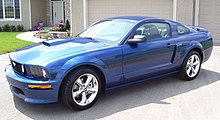
In 2006, Ford introduced the GT California Special (GT/CS) package, hearkening back to the original 1968 California Special Mustang. The package adds 18" polished aluminum wheels, non-functional side scoops, and unique vinyl striping that replaced the side GT emblems. The GT/CS also included a unlike front fascia and rear valance with diffuser, similar to those found on the Shelby GT. The GT/CS edition'due south front end fascia was one.five inches lower to the ground than the standard GT. Interior upgrades included Mustang labeled floor mats, and CS only leather interior color options. The 2007 GT Appearance Package adds a hood scoop, exhaust tips, and engine cover.
In 2010, the GT California Special was re-introduced as optional on the Mustang GT. Black GTCS side stripes which faded into a side scoop. The front fascia was replaced with the one used in the 2011 Boss 302 with working lower fascia fog lights. The rear diffuser was taken from the Shelby GT 500 while the rear deck lid featured blackness vinyl and a fly spoiler. Wheels were argent spoke 19 inch with a GT logo stamped towards the outer rim on each wheel. The interior's bright nuance was replaced with black carbon cobweb handling, while carbon fiber door inserts and seat leather patterns were added. Badging included "GTCS" on the carbon fiber dash and floor mats. The front Grill was brushed aluminum barracks with a V6 way pony emblem on the driver's side. (for 2012, it was inverse to black billet). Rear axle gear selections were 3.31, 3.55, or 3.73.
2008–2009 Bullitt [edit]

2008 Ford Mustang Bullitt
The Mustang Bullitt returned in February 2008 as a variant of the Mustang GT, the terminal version of which was produced in 2001. It is reminiscent of the Dark Highland Green GT-390 fastback Mustang driven past Steve McQueen in the 1968 motion picture Bullitt. Available in Dark Highland Green or Black exterior pigment without spoiler and GT fender emblems; the faux gas cap on the deck lid is replaced by a unique Bullitt version. The Mustang GT's standard fog light-equipped grille is replaced with a specially designed pony-less way grille highlighted by an aluminium accent. Night Silvery Gray 18-inch cast-aluminum euro-flange wheels are used with matching brake calipers and larger, 3.5 inch frazzle tips supervene upon the Mustang GT'due south standard 3 inch tips. Although side (quarter) window louvers (every bit shown in motion picture) are not standard, they are added by owners because they are similar to those on the 1968 Mustang fastback.
The Bullitt uses a version of the Mustang GT's aluminum 4.6 L SOHC V8. It has a cold air intake, improved engine calibration, and a revised exhaust system designed to mimic the sound of the Mustang used in the Bullitt movie. Total output is 315 hp (235 kW) at 6000 rpm and 325 lb⋅ft (441 N⋅grand) of torque at 4250 rpm and the engine's redline has been raised to 6500 rpm (from the standard Mustang GT'southward 6250 rpm). Premium grade, 91-octane or better gasoline is recommended, although an adaptive spark ignition arrangement allows the engine to accept regular grade gasoline. Total output is the same with either fuel, but the engine delivers a flatter torque curve when using premium. The Tremec TR-3650 5-speed manual manual from the Mustang GT is used, but the Bullitt featured a heavier duty rear axle (also used in GT500KR) with three.73:i ratio, versus the Mustang GT's 3.31:1 or optional 3:55:1 ratios. The suspension is improved over the standard GT utilizing stiffer springs, struts, and a decorative forepart strut tower caryatid while also lowering the car's ride height by 6 millimeters.[30] Most of the Mustang Bullitt's components are available in the aftermarket for retrofitting earlier S197 Mustang GT vehicles, but some parts used in Bullitt Mustangs are marked to show actuality.
The 2009 Mustang catalog indicate the Bullitt package was available on manual transmission Mustang GT Premium coupes as a regular production option; the same colour restrictions use.
45th Anniversary Edition (2009 GT) [edit]

2009 Mustang GT 45th Anniversary Badge

2009 Mustang GT 45th Anniversary Edition (with custom quarter window louvers)
Features of the 2009 Mustang include a glass top roof option, too as special 45th Anniversary badging to commemorate the original Mustang's launch in 1964. A full of 46,420 were built.[25] Satellite radio was standard on premium interior models, and Deluxe was no longer used to identify base models. This model has the same engine and functional equipment as a bones GT. The 2009 45th Anniversary edition is badged with a Mustang Colt emblem, with the 45th Ceremony logo. Information technology included with an optional hood scoop and polished stainless steel exhaust tips bundle, rear spoiler, the Ambience Lighting packet was now standard and included with the price of the vehicle at no additional cost, and 17" polished aluminum wheels were optional (17" wheels were standard only this model year used the aforementioned silver v spoke wheels since 2007).
Iacocca Silver 45th Ceremony Edition (2009½ GT) [edit]
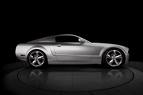
The 2009 Iacocca Silver 45th Anniversary Edition was a 45 unit production also commemorating the 45th anniversary of Ford Mustang. Named for Lee Iacocca who helped develop and innovate the Mustang. It was designed by Michael Leone (I Legacy & Michael Leone Blueprint) and built by California-based Gaffoglio Family Metalcrafters coachbuilding company. Despite its aftermarket build status, it carries factory engine and warranties. Iacocca was given car 1 of the 45. I was afterwards auctioned for $352,000.[31]
Shelby GT500 (2007–2009) [edit]


Shelby GT500 (with export modifications)
For 2007, Ford's SVT launched Shelby GT500, a successor to the 2003/2004 Mustang SVT Cobra. The GT500 shared bones design characteristics with that of the Mustang V6 and GT. Information technology retained the same basic alive beam rear interruption setup of the Mustang V6 and GT, with some minor durability enhancements such as thicker sheet metal supports and extra welds, every bit well as redesigned strut towers to adjust a wider engine. The supercharged and intercooled v,408 cc (5.4 L; 330.0 cu in) DOHC 4 valves per cylinder V8 engine with an iron block and aluminum heads was rated at 500 bhp (507 PS; 373 kW) at 6000 rpm and 480 lb⋅ft (651 N⋅m) of torque at 4500 rpm.[32] The Tremec TR6060 6-speed transmission manual used a three.31:1 rear drive ratio. Wheels are 18×ix.5 inch with P255/45ZR18 tires in the front and P285/40ZR18 tires in the rear. Brembo fourteen-inch disc brakes with aluminum four-piston calipers are on the front with eleven.viii-inch disc brakes with unmarried-piston calipers in the rear.[33]
The GT500 failed to run into some automotive journalists' expectations.[34] [35] Automobile and Driver magazine, for example, though praising the GT500 for its aplenty horsepower and relatively polish ride, criticized their test auto for its heavy weight and, in particular, the olfactory organ-heavy weight distribution of 57.7% front and 42.3% rear (compared to the 52.v% front, 47.5% rear of a Mustang GT manual they tested).[36] Notwithstanding, in spite of their stance of its drawbacks, Auto and Driver drove a GT500 in their 2007 "Lightning Lap" road examination at Virginia International Raceway and found that the car's on-track performance lap time of 3:05.9 fell just beneath that of the Porsche 911 Turbo (3:05.8) and faster than that of the Lotus Elise (3:09.3), Porsche Cayman S (iii:09.5) and BMW M6 (3:x.0).[37]
Shelby GT500KR [edit]


Debuting equally a 2008 model and continuing for 2009, the Shelby GT500KR ("KR" existence an abbreviation for "King of the Road") pays homage to the original 1968 Shelby Mustang of the same name. Production for '08 was express to 1011 units (including prototypes), with another 712 KR models built for '09. The KR featured new components and operation enhancements over the standard GT500. The KR's engine was tuned to produce 540 hp (547 PS; 403 kW) at 6250 rpm and 510 lb⋅ft (691 Northward⋅yard) of torque at 4500 rpm, gains of 40 hp (thirty kW) and xxx lb⋅ft (41 N⋅thou) of torque, respectively over the GT500's. The rear axle has a 3.73:1 ratio. To improve handling and help offset the car's front-heavy weight distribution, the GT500KR featured a Ford Racing strut tower brace and uniquely tuned struts, shocks, and springs. Using a carbon fiber hood and a revised exhaust organisation, the overall weight of the GT500KR was 22 lb (10 kg) lighter than a standard GT500.[38]
Engines [edit]
| Model | Years | Power, torque@rpm |
|---|---|---|
| Mustang (iv.0 L V6) | 2005–2010 | 210 hp (157 kW)@5300, 240 lb⋅ft (325 N⋅m)@3500 |
| Mustang GT (4.6 L V8) | 2005–2009 | 300 hp (224 kW)@5750, 320 lb⋅ft (434 N⋅m)@4500 |
| Shelby GT500 (five.four L SC V8) | 2007–2009 | 500 hp (373 kW)@6000, 480 lb⋅ft (651 North⋅m)@4500 |
| Mustang Bullitt (iv.6 L V8) | 2008–2009 | 315 hp (235 kW)@6000, 325 lb⋅ft (441 Due north⋅m)@4250 |
[39] [40]
Motorsports [edit]
In autocross, the S197 Shelby GT Mustang won the SCCA Pro Solo championship in the F-stock form from 2007 to 2009.[41]
A Mustang won the drivers, team and manufacturers' championships for both the 2008 and 2009 seasons of Grand-Am Koni Challenge.[42]
In 2009, the Mustang also won the SCCA Pro Racing World Claiming GT title. Blackforest Motorsports has entered a Mustang in the Rolex Sports Car Series GT course.[43]
2010 model year update [edit]
2010 Mustang [edit]
| 2010–2014 Mustang S-197 Ii | |
|---|---|
 | |
| Overview | |
| Production | January 12, 2009 – June twenty, 2014[44] [45] |
| Model years | 2010–2014 |
| Designer | Doug Gaffka (S-197 2 design chief: 2005–07) George Saridikas (exterior: 2005, 2006) Robert Gelardi (interior: 2006, MY2013 facelift exterior: 2010)[2] [46] [47] |
| Body and chassis | |
| Platform | Ford D2C Platform |
| Powertrain | |
| Engine | three.vii L Duratec V6 (Max speed 120 mph) 4.0 Fifty Cologne V6 (2010 Only) 4.6 L Modular V8 (2010 Only) 5.iv L Modular supercharged V8 v.0 Fifty Coyote V8 (Max speed 145 mph) v.eight Fifty Modular supercharged V8 (Max speed 200+ mph) |
| Transmission | 5-speed manual (TR-3650) 6-speed manual (TR-6060, Getrag / Ford MT82) 5-speed automatic (5R55S) 6-Speed (6R80) Automatic |
| Dimensions | |
| Wheelbase | 107.one in (2,720 mm) |
| Length | 188.ane in (iv,780 mm) |
| Width | 73.ix in (i,880 mm) |
| Pinnacle | 55.6 in (ane,410 mm) (Coupe) 56.1 in (1,420 mm) (Convertible) |
| Adjourn weight | V6 coupe MT/AT: 3,401 lb (1,543 kg)/three,454 lb (1,567 kg) V8 GT coupe MT/AT: 3,533 lb (ane,603 kg)/three,575 lb (1,622 kg) V8 GT500 coupe MT: three,852 lb (1,747 kg) |
| Chronology | |
| Predecessor | 2005–2009 Mustang (S-197 I) |
| Successor | 2015–present Mustang (S550) |
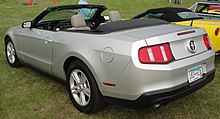
The 2010 model year Mustang was unveiled on Nov 18, 2008, prior to the Los Angeles International Machine Show. Production began on January 12, 2009 and it went on sale in March 2009.[48] The 2010 Mustang was a revision of the 2005–2009 models, retaining the D2C platform.
Design and evolution work began in 2004, with September 29, 2005 being when designer George Saridikas' exterior proposal was called, likewise as Robert Gelardi's interior proposal under master Due south-197 designer Doug Gaffka. Doug Gaffka after, became immediately responsible for the design of the 2008–2009 Bullitt and the GT500KR, upon MY2010 design selection in 2006. The resulting production exterior design of late 2006 was essentially revised, resulting in better aerodynamic performance (Ford claimed the coefficient of elevate was reduced past 4% on V6 models and 7% on GT models, and that the front aerodynamic lift was reduced by 37% for V6 models and 23% for GT models.[49]).
Specific changes to the exterior include a restyled Mustang keepsake,[50] a new headlight blueprint with integrated turn signals, new slimmer side mirror pattern, a prominent "powerdome" hood, and revised three-lens taillights with LEDs that glimmer in sequence for turn indication. Additionally, the 2010 Mustang GT used smaller fog lights than the 2005–2009 models though they were nonetheless mounted in the car's grille. Fog lights on V6 models (a part of a revised Pony Package first introduced for 2006) are now mounted in the lower fascia below the grille. The radio antenna had been moved to the rear of the car and the lock for the trunk no longer featured a keyhole on the trunk lid, substituting with a remote trunk release only.[51] In spite of its changes, the 2010 Mustang's overall exterior dimensions were nearly identical to the 2005–2009 models.[52]
The Mustang'southward interior was revised featuring higher quality thermoplastic olefin surfaces, available existent aluminium trim, and improved fit and finish. The new pattern moved abroad from the linear nature of the previous models. Ford SYNC became bachelor equally a factory installed option on all trim levels of the Mustang except the base model.
This generation was the first to exist sold in Japan in left manus drive course with outside lighting modifications to comply with Japanese Government regulations.

The standard engine was a 4.0 L V6 mated to a 5-speed manual transmission or an optional 5-speed automatic transmission. The V6 powertrains were unchanged from those used in 2005–2009 Mustangs. Though the 2010 Mustang Five-half dozen retained a single frazzle outlet, the diameter of the tip had been increased half of an inch to 3 inches.[53] The 2010 Mustang included new jump rates and dampers to improve ride quality and control and Ford'southward AdvanceTrac traction and stability control system standard. Newly standard on the base Mustang were 17-inch painted aluminum wheels while eighteen-inch wheels continue to be optional (except for V8 models, where 18-inch wheels were mounted by default). Other new bachelor features and options for the 2010 Mustang included Ford SYNC, dual-zone automated climate command, an updated navigation arrangement with Sirius Travel Link, a capless fuel filler, a opposite camera organization to assist in backing up, and an updated version of the V6 Pony Package.[52]
2011–2012 Mustangs [edit]
For 2011, the aging 4.0 Fifty V6 used in the Mustang since the 2005 model year was replaced with Ford's Duratec 37 3.vii 50 DOHC V6. Unlike earlier V6s, the new engine featured Twin-independent Variable Cam Timing (Ti-VCT), true dual exhaust (compared to the unmarried outlet exhaust for the previous iv.0 L V6); this engine was rated to produce an improved 305 bhp (227 kW) at 6500 rpm and 280 lb⋅ft (380 N⋅thou) of torque at 4250 rpm.[54]
The upgraded powertrains were capable of achieving improve fuel efficiency due in part to the new transmissions. With the standard Getrag MT82 6-speed manual transmission co-developed with Ford, the Mustang had been rated by the EPA to reach 19 mpg‑US (12 L/100 km; 23 mpg‑imp) in metropolis driving and 29 mpg‑U.s. (8.1 50/100 km; 35 mpg‑imp) on the highway. The newly optional Ford 6R60 6-speed automated achieved 19 mpg‑US (12 Fifty/100 km; 23 mpg‑imp) in metropolis and 31 mpg‑US (7.6 L/100 km; 37 mpg‑imp) on the highway.[55] A newly standard ii.73:1 limited slip rear beam was more fuel efficient compared to the more aggressive 3.31:1 axle used previously. The 3.31:i beam remained available in the 2011 Mustang every bit a performance option.[54]
The 2011 Mustang offered a V6 Performance Packet starting in the summer of 2010. The package featured a standard 3.31:1 rear axle, stiffer suspension tuning, 19-inch wheels with performance tires, a strut belfry brace, and performance-oriented electronic stability control calibration.[54]
Other, non-powertrain related upgrades made to the 2011 Mustang included a Nexteer Automotive Electric Ability Steering (EPS) system with pull-drift compensation and agile crumb command, general aerodynamic and NVH improvements over the 2010 Mustang, a digital message/information center, bullheaded spot mirrors integrated into the car's side mirrors, a universal garage door opener, a 160 mph speedometer, and Ford's MyKey programmable vehicle key engineering science.[54]
Cobra Jet (2012) [edit]
The Mustang Cobra Jet is a 2012 Mustang that was the same design as the GT500 but information technology has wider tires and a bigger engine. Cobra Jet Mustangs were sold only to professional drag racers and came without a VIN, making it incommunicable to register them as a road automobile.
2013–2014 Mustangs [edit]

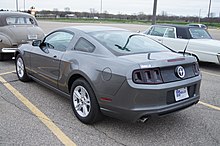
Between 2009 and 2010, evolution took place on further updates to the second generation South-197. In belatedly 2010 blueprint work (by Robert Gelardi) was frozen, with prototypes beingness first spotted in May 2011. On November 2, 2011, Ford unveiled the 2013 model year Mustang. The 2013 model yr Mustang exterior was updated with a new forepart fascia featuring a larger grille, standard HiD headlamps and 2 LED accent strips side by side to the headlamp lens. Models equipped with the Pony Packet offered LED lighting mounted on the side-view mirrors that produce a projection of a running horse on the ground, 18" wheels, and lower valance fog lamps. In the rear, LED tail lamp clusters included sequential turn signals (equally with 2010–2012 Mustangs) and a opposite indicator light integrated within the restriction light. The trunk chapeau included a black console that united the left and right tail lamp clusters. Several new bicycle designs were offered.
Inside, Ford now offered a 4.two" display between the speedometer and tachometer on Premium models. Selections in this information brandish included G-force, acceleration times, air-fuel ratio, cylinder caput temperature, and oil temperature. All models equipped with the 6-speed automatic transmission included a SelectShift characteristic, which provided drivers the power to cull and concord a gear and to shift manually.
Mustang GT [edit]
2010 [edit]

The 2010 Mustang GT added a more powerful version of the iv.half-dozen L V8 seen in 2005–2009 Mustang GTs. The Mustang GT'southward revised V8 produced 315 bhp (235 kW) at 6000 rpm and 325 lb⋅ft (441 N⋅m) of torque at 4250 rpm. The five-speed transmission and automated transmissions offered with the updated V8 connected unchanged from earlier. The size of the 2010 Mustang GT'south dual frazzle tips had been increased by one-half of an inch to 3.5 inches while the exhaust annotation has been improved to enhance the sound of the V8.[53] Like the base of operations V6-equipped Mustang, the 2010 Mustang GT included new spring rates and dampers to improve ride quality and control. AdvanceTrac was too standard in the Mustang GT though a special Sport Mode setting was added for spirited driving. The 2010 Mustang GT came with standard eighteen-inch wheels – ane inch greater than the previous Mustang GT's standard wheels – while 19-inch wheels were a new option.[52]
Newly available for the Mustang GT for 2010 were 2 operation packages. The 3.73 Axle Package featured college performance front brake pads, a more aggressive three.73:ane rear axle, and a recalibrated AdvanceTrac arrangement. The Rail Package featured college performance forepart and rear brake pads, stabilizer bars and rear lower command arms from the GT500, uniquely tuned shocks and struts, Pirelli summertime tires (includes automatic upgrade to 19-inch wheels), a 3.73:1 rear axle with carbon plates in the differential, and a recalibrated AdvanceTrac system.[49] [56]
2011 & 2012 5.0 GTs [edit]
Starting in belatedly 2010 for the 2011 model year, the Mustang GT's engine became an all-aluminum 32-valve 5.0 L DOHC V8, codenamed Coyote. The 2011 Mustang GT marked this engine's start use in whatsoever production Ford. While the new engine'southward displacement was similar to Ford's original "5.0" iv.9 L (302 cu in) V8, it was an unrelated design and instead shared more than in common with the four.6 L V8 and other Modular engines that it replaced. The new 5.0 used a DOHC head pattern like other Modular engines and even shared its diameter spacing and deck height with the approachable four.half-dozen L V8. Differing the new engine from earlier Modular engines, amidst other features, was its utilise of wider diameter diameters (and a longer stroke relative to the iv.half dozen L V8 in particular), to allow the use of larger valves, and camshaft torque-actuated Twin-independent Variable Cam Timing (Ti-VCT). This more than advanced pattern is approximately 430 lb (195 kg) – almost ten lb (5 kg) heavier than the Mustang GT's previous four.vi L V8. Red-line had been raised to 7,000 rpm. Using premium grade, 91-octane or higher gasoline, the new 5.0 L V8 could produce 412 bhp (307 kW) at 6500 rpm and 390 lb⋅ft (529 Due north⋅m) of torque at 4250 rpm.[57] Output of the 5.0 drops to 402 bhp (300 kW) at 6500 rpm and 377 lb⋅ft (511 Due north⋅m) of torque at 4250 rpm when regular grade gasoline is used.[58]
The new 5.0 incorporates piston cooling oil jets that helped warm the engine faster and keep the engine running cooler under load. Racing style tubular headers replaced the standard cast iron headers. Coolant and oil flow patterns were optimized for proper catamenia when under high lateral forces, such as those experienced when on a route form track.
The Mustang GT also got new transmissions for 2011. Both transmissions are heavier duty versions of the aforementioned designs offered with the V6 Mustang; a Getrag/Ford MT82 6-speed transmission transmission and Ford'due south 6R80 vi-speed automatic transmission. The 6-speed manual transmission came with a three.31:i rear beam while 6-speed automatics go a taller 3.15:ane rear axle. Combined with its new & more efficient V8, the new 6-speed transmissions contributed to an improvement in fuel economy in the 2011 Mustang GT over its analogue from the 2010 model year. Equally certified by the EPA, manual manual models were able to attain 17 mpg‑U.s. (14 L/100 km; 20 mpg‑imp) in city and 26 mpg‑United states of america (9.0 L/100 km; 31 mpg‑imp) on the highway while automatic transmission models were able to achieve 18 mpg‑United states (13 50/100 km; 22 mpg‑imp) in city and 25 mpg‑US (9.4 L/100 km; xxx mpg‑imp) on the highway.[59]
The Mustang GT gained the same non-powertrain related upgrades that standard V6 Mustangs got for 2011. Other, new features sectional to the 2011 Mustang GT included "five.0" fender badges replacing the "GT" badges used previously, an optional Brembo Restriction Package includes xiv inch Brembo front disk brakes taken from the Shelby GT500, unique 19-inch wheels with Pirelli P-Zero ultra high functioning summer only tires, a unique scale of the Advanced Track stability system including a "sport" mode, and interruption enhancements such as stiffer springs (less aggressive than the Dominate 302 and Shelby models but more than so than the regular GT models) and various other intermission enhancements. Convertible versions of the Mustang GT in particular received a front strut belfry brace, stiffened crossmembers, and other enhancements resulting in a 12% increase in structural rigidity compared to 2010 Mustang GT convertibles. All 2011 Mustang GT's with 19 inch wheels (Brembo restriction equipped, California special, etc.) as well received the strut tower brace and stiffened cross members.
Taller rear head rests were added in the middle of the 2012 model year for whiplash protection, with fold down feature for visibility when rear passengers are not nowadays. The rear fascia is contradistinct for slightly improve aerodynamics than the 2010 every bit well.[57]
'Loftier Gear' concept (2012) [edit]
The Mustang 'High Gear' concept is a concept motorcar designed past Jennifer Seely of Ford and based on a 2013 Ford Mustang GT. The design was inspired by international products in categories such as jewelry, couture clothing, and architecture. The vehicle included rose-golden chrome accents throughout the exterior and interior; satin-black body; quilted suede seats with leather-wrapped interior upholstery. Modifications were also fabricated to the engine, undercarriage, drivetrain, and sound system. The vehicle was unveiled at the 2012 SEMA show, during the get-go SEMA Mustang Build Powered by Women event.[60]
2013–2014 Mustang GT [edit]


Changes for the 2013 model year included standard "blacked out" tail lights and a front end fascia similar to the styling of the Shelby GT500 models. The GT models include LED fog lights mounted in the grille and functional rut extractors on the sides of the hood. The engine gained viii horsepower (half dozen kW) for a full of 420.
A new Track Parcel was offered for manual transmission GT Coupes.
GT Rail Package included the complete Brembo Brake package, a 3.73:1 Torsen helical cut limited slip differential, Boss 302 aluminum radiator, Boss 302 engine oil cooler, and numerous suspension changes.[61]
Recaro sport seat choice added for the Coupe.
U.S. Air Strength Thunderbirds Edition 2014 Ford Mustang GT (2013) [edit]
To commemorate the 60th anniversary of the U.S. Air Force Thunderbirds, Ford released a single special edition 2014 Ford Mustang GT coupe, VIN 0001. The automobile is white with red and bluish accents and features USAF markings and logos, wide body modifications, a handcrafted and painted belly pan by Creations north' Chrome that emulated the appearance of an F-16 Thunderbird, front and rear wide body elements by TS Designs, custom 22-inch wheels by Forgiato, a modified navigation screen, instrument cluster, rear seat delete, Recaro seats with embroidered Thunderbirds elements, unique sill plates and puddle lamps, a Ford Racing supercharger, pause handling pack and Brembo brakes.
The vehicle was sold at the Gathering of Eagles charity consequence during the Experimental Shipping Association (EAA) AirVenture Oshkosh 2013.[62] The vehicle was purchased past James Slattery of San Diego, California for $398,000.[63]
Mustang Boss 302 [edit]
| 2012 Dominate 302 | |
|---|---|
 | |
| Overview | |
| Production | 2011–2013 |
| Designer | Robert Gelardi (2009)[64] Melvin Betancourt (facelift: 2010) |
| Body and chassis | |
| Body mode | 2-door Coupe |
| Platform | fifth Generation Mustang |
| Powertrain | |
| Engine | v.0 L V8 |
| Transmission | 6-speed manual |
| Dimensions | |
| Wheelbase | 107.1 in (two,720 mm) |
| Length | 188.1 in (iv,780 mm) |
| Width | 73.ix in (ane,880 mm) |
| Height | 55.6 in (ane,410 mm) |
| Curb weight | 3,631 lb (ane,647 kg) |
Ford revived the Boss 302 nameplate for 2012. The standard 2011 Ford Mustang GT's 5.0-liter V8 is enhanced with an upgraded intake arrangement, forged rotating associates, CNC ported heads, revised camshafts and a high menstruum "runners in the box" intake taken from the 302R racecar.[65] It produces 444 hp (331 kW) – 32 hp (24 kW) over the standard GT'due south 412 hp (307 kW). The engine produces 380 lb⋅ft (515 North⋅chiliad) of torque, about 10 lb⋅ft (fourteen N⋅m) of torque less at pinnacle when compared to the standard GT, and comes with a vi-speed MT-82 manual transmission. A 3.73 rear axle uses carbon fiber plates in its limited skid differential or an optional Torsen differential.
The quad exhaust system is made up of two standard Mustang GT outlets and 2 side pipes that exit on either side of the rear crossover. The side pipes send the exhaust through a gear up of metal "attenuation" discs to create an extra growling exhaust sound. The discs are removable and include a spacer plate sized to match aftermarket frazzle dump valves.
The Boss 302 takes the Mustang GT'southward suspension and adds college-rate coil springs, stiffer bushings, and a larger bore rear stabilizer bar. The body is lowered eleven mm (0.4 in) up front and just ane mm (0.0 in) in the rear to give it a more than raked stance designed to think the original. The shocks are adaptable at the daze tower by using a flat head screwdriver. The standard Mustang traction and stability control programs have been contradistinct with a new intermediate sport way designed to allow for more than flexibility on the track.
The aero package is about entirely copied from the Dominate 302R race car. The xix-inch black-alloy racing wheels are 9-inches wide up front and 9.five-inches out back and come with Pirelli P-Zero tires.
While more powerful than a standard GT, the Boss 302 did not offering many of the luxury amenities of other Mustang models. Features not available on the Dominate 302 included a premium audio organisation, a Bluetooth phone organization (the Ford Sync system was added on later on models), SiriusXM Satellite Radio, and power-adjustable front end seats.[66]
Boss 302 Laguna Seca edition [edit]

Laguna Seca edition has map of runway on rear badge
The Boss 302 Laguna Seca edition is a further upgraded version of the Boss 302. Additions include Recaro sport seats, a Torsen express-slip rear differential (both optional on the standard Boss 302), revised suspension tuning with unique leap and damper rates, and a larger rear stabilizer. The Laguna Seca model loses its rear seats, which are replaced by a cross-car Ten-brace to increment structural rigidity approximately 10%. It rides on 19X9-inch front and 19X10 inch rear light-weight alloy wheels with R-compound ultra high-functioning tires. Ford Racing front restriction ducts help cool the brakes.
The 2012 Laguna Seca Dominate 302 comes in 2 colors – Black or Ingot Silver – with a red roof and red accents. For 2013, colour choices include both Schoolhouse Bus Yellow and Black, both with reflective matte silverish stripes. A more ambitious forepart splitter and a larger rear spoiler increase downforce for high speed track apply. Only 750 Laguna Seca versions volition exist built each year for the two-year run (for a total of 1500).[65]
The limited-edition Laguna Seca is designed to bridge the gap between the Boss 302 and the Boss 302R.[67] [68]
Shelby GT500 [edit]


The 2010 Shelby GT500 was revealed by Ford through a press release on Jan 1, 2009, prior to a public unveiling at the 2009 North American International Car Show. Many of the basic design characteristics of the new GT500 are shared with that of the Mustang and Mustang GT. The GT500 gains the aforementioned exterior and interior updates as the 2010 Mustang and Mustang GT. The front end fascia is new with larger upper and lower grilles, a unique hood, large fog lights mounted in the lower front end fascia (similar to the previous GT500), Shelby'southward signature cobra badges on the grille, front fenders, and trunk lid medallion (with Shelby lettering over the medallion), 19-inch wheels (18-inch on the convertible model), and a Gurney Flap rear spoiler. Inside the GT500 gains a cobra disc on the steering wheel, shift ball, and seats with embroidered cobras.[69]
Mechanically the 2010 Shelby GT500 remains closely related to the 2007–2009 GT500, only the 2010 model has been upgraded with various features similar to or found in the 2008 Shelby GT500KR. A conical cold air intake and other enhancements to the GT500's supercharged 5.four L DOHC V8 have resulted in an increase in output to 540 bhp (403 kW) at 6200 rpm and 510 lb⋅ft (691 N⋅m) at 4500 rpm, gains of 40 bhp (30 kW) and 30 lb⋅ft (41 N⋅k) of torque over the 2007–2009 GT500 respectively. The Tremec TR-6060 vi-speed manual manual returns for the 2010 GT500 but has been enhanced with larger clutch discs (250 mm (ix.8 in) versus the 215 mm (eight.v in) discs used previously) and other measures to increase functioning and noise, vibration, and harshness (NVH) control. Additionally, the fifth and sixth gear ratios of the transmission accept been inverse from 0.80 to 0.74 and 0.63 to 0.50 respectively, contributing to an comeback in fuel efficiency that the 2010 GT500 enjoys over its predecessor. Complementing the transmission's gear ratio changes is a new, more aggressive three.55:1 ratio rear axle which replaces the 3.31:one beam used previously. According to Within Line, drivers of the new 2010 Shelby can expect 0 to 60 mph (97 km/h) times in 4.3 seconds from a stand up still and 4 seconds apartment with roll out.[ needs update ] Elsewhere, the GT500's aluminum hood, in addition to exist stylistically unlike from that of the Mustang and Mustang GT, features an air extractor that helps cool the engine. Various aerodynamic upgrades, such as the design of the front fascia and the aforementioned Gurney Flap spoiler, contribute to increased down force and a reduced coefficient of elevate. Pause enhancements found in the GT500KR are used in the 2010 GT500 to improve handling and, specifically, provide better roll control. The 2010 GT500 features Ford'south AdvanceTrac traction and stability command organisation standard with different settings to control the level of operation the driver desires.[69]
The 2010 Shelby GT500 was released in the leap of 2009.
2011–2012 [edit]
For 2011, the Shelby GT500 received pregnant functioning enhancements and other upgrades. Arguably the most important of the GT500's upgrades is a new aluminum engine block for the car's supercharged 5.four Fifty DOHC V8, replacing the cast-fe cake used previously. The block'due south cylinder bores are coated with an atomic number 26 and iron oxide blended that is practical with Plasma Transferred Wire Arc (PTWA) technology, which was developed jointly past Ford and Flame-Spray Industries.[ citation needed ] The developers of PTWA received the IPO 2009 National Inventor of the Year award. The coating allows for the replacement of traditional cast-iron cylinder liners and marks Ford'south kickoff use of this process. Betwixt this and the utilize of lighter-weight aluminum for the engine cake, the new block is 102 lb (46 kg) lighter than the previous bandage-fe version, contributing to a reduction in the overall weight of the GT500 compared to the 2010 model. Thanks to the new liner coating, which has friction-reducing characteristics, and a revised frazzle, horsepower production from the 5.iv L V8 has increased slightly for a total of 550 bhp (410 kW) at 6200 rpm. The combination of the lighter engine, EPAS, and aerodynamic enhancements outcome in an improvement in fuel efficiency for the 2011 GT500 relative to the 2010 model that eliminates the car'southward gas guzzler tax.[70]
A newly optional SVT Performance Package includes a three.73:1 rear axle, Goodyear Eagle F1 SuperCar G:2 tires, forged aluminum 19-inch wheels in the forepart and 20-inch in the rear, equally well as a firmer pause tuning.[71]
The 2011 Shelby GT500 gains the same not-powertrain related upgrades that standard V6 Mustangs and Mustang GTs. New features include standard HID headlights and a drinking glass roof selection.[70]
2013 [edit]
The 2013 Shelby GT500 features the 5.8L Trinity V8 engine rated at 662 bhp (671 PS; 494 kW) at 6500 rpm and 631 lb⋅ft (856 N⋅k) at 4000 rpm of torque, with a height speed of 202 mph (325 km/h).
The 2013 models gain a new forepart stop canvass metal along with standard HID headlamps, forth with a new LED tail light assembly. Functioning changes include twin fuel pumps (a Mustang GT'southward single supply pump, twice over), larger fuel injectors, a grippier and larger-diameter clutch, a larger fan, a 3-row intercooler (the previous car used a double-row unit), a beefed-upward Tremec 6060 six-speed with an internal oil pump, and a single-piece carbon-cobweb driveshaft. Larger Brembo forepart disc brakes with six-piston calipers, reinforced axle tubes, and aero tweaks to aid the machine accomplish 200+mph safely. Ford says the changes take resulted in a 14-percentage reduction in drag and a 66-percentage increment in front end-end downforce. Likewise new for 2013 is a larger front anti-roll bar and retuned springs. An rpm-adaptable electronic launch-control function is standard, as is four-mode electronic stability control.
A Performance bundle is as well offered, adding two-mode adjustable Bilstein dampers and a Torsen limited-slip rear differential. In addition to the performance package, a track package for road racing can be ordered bringing a transmission cooler, a nose-mounted differential cooler for the Torsen limited-sideslip unit, and an air-to-oil engine-oil cooler.
Engines [edit]
| Model | Years | Power @ rpm | Torque @ rpm |
|---|---|---|---|
| Mustang (four.0 50 V6) | 2005–2010 | 210 hp (157 kW) @ 5300 | 240 lb⋅ft (325 N⋅g) @ 3500 |
| Mustang (3.vii L V6) | 2011–2014 | 305 hp (227 kW) @ 6500 | 280 lb⋅ft (380 N⋅m) @ 4250 |
| Mustang GT (4.6 50 V8) | 2005–2009 | 300 hp (224 kW) @ 5750 | 320 lb⋅ft (434 N⋅m) @ 4500 |
| Mustang GT (4.6 Fifty V8) | 2010 | 315 hp (235 kW) @ 6000 | 325 lb⋅ft (441 N⋅m) @ 4250 |
| Mustang GT (five.0 L V8) | 2011–2012 | 412 hp (307 kW) @ 6500 | 390 lb⋅ft (529 N⋅k) @ 4250 |
| Mustang GT (5.0 L V8) | 2013–2014 | 420 hp (313 kW) @ 6500 | 390 lb⋅ft (529 North⋅m) @ 4250 |
| Shelby GT500 (5.4 L SC V8) | 2010 | 540 hp (403 kW) @ 6000 | 510 lb⋅ft (691 Northward⋅m) @ 4800 |
| Shelby GT500 (5.4 50 SC V8) | 2011–2012 | 550 hp (410 kW) @ 6200 | 510 lb⋅ft (691 North⋅m) @ 4250 |
| Shelby GT500 (5.8 L SC V8) | 2013–2014 | 662 hp (494 kW) @ 6500[72] | 631 lb⋅ft (856 N⋅m) @ 4000 |
| Boss 302 (5.0 L V8) | 2012–2013 | 444 hp (331 kW) @ 7500 | 380 lb⋅ft (515 N⋅chiliad) @ 4250 |
Motorsports [edit]
Ten Mustangs are currently used in the SCCA World Claiming GTS Serial.[73]
Twelve Mustangs are currently used in the Continental Tire Sports Car Claiming Gran Sport class.[74]
A Mustang resembling the Trans Am Series Mustang driven past Parnelli Jones has been entered in the Continental Challenge, tributing the fortieth anniversary of Parnelli'south championship.[75]
The Ford Mustang is used in the NASCAR Nationwide Series every bit a silhouette racing machine beginning on July 2, 2010.[76]
Mustangs have also been raced in the FIA GT3 and GT4 championships.
In 2012, Jack Roush won the Daytona International Speedway's opening race of the 50th Anniversary Rolex 24 At Daytona weekend in a Mustang Boss 302R. Leading the Continental Tire SportsCar Challenge's last 18 laps, Johnson held off a veritable conga line of six BMW M3's backside as he closed on the driving pair'due south outset win of 2012 in the BMW Operation 200 at Daytona.[77]
Sales [edit]
| Model year | The states | Canada | Europe |
|---|---|---|---|
| 2005 | 160,975[78] [79] | 10,045[80] | 745[81] |
| 2006 | 166,530[82] [79] | 9,150[lxxx] | 752[81] |
| 2007 | 134,626[82] [79] | 7,987[80] | 602[81] |
| 2008 | 91,251[83] [79] | 6,261[80] | 904[81] |
| 2009 | 66,623[84] [79] | 5,200[80] | 511[81] |
| 2010 | 73,716[85] [79] | 5,232[80] | 747[81] |
| 2011 | 70,438[79] | four,433[fourscore] | 994[81] |
| 2012 | 90,706[79] | 5,181[80] | 951[81] |
| 2013 | 77,186[79] | 5,054[fourscore] | 635[81] |
| 2014 | 82,635[79] | five,605[80] | 556[81] |
| Total | ane,014,686 | 64,148 | seven,394 |
References [edit]
- ^ Quiroga, Tony (January one, 2005). "2005 Pontiac GTO vs. 2005 Ford Mustang GT". Machine and Driver. U.s.. Retrieved September 26, 2020.
- ^ a b Leffingwell, Randy; Newhardt, David (2003). Mustang: Forty Years. Motorbooks International. p. 371. ISBN9780760315972 . Retrieved June 23, 2014.
- ^ McMorrow, Mallory (November twenty, 2013). "Sketches of what the current Mustang could have looked similar". Roadandtrack.com. Retrieved June 23, 2014.
- ^ Raynal, Wes (2004). "Looking Like a Fast Machine". AutoWeek. 54 (6): 16–21. ISSN 0192-9674.
- ^ Phillips, Drew (March xvi, 2009). "Barrett-Jackson to auction start 2010 GT500, two concept Mustangs in Palm Beach". Autoblog.com. Retrieved Jan iv, 2011.
- ^ Leffingwell, Randy; Newhardt, David (2003). Mustang: Twoscore Years. Motorbooks International. p. 375. ISBN9780760315972 . Retrieved June 23, 2014.
- ^ "Barrett-Jackson Lot: 655 – 2004 Ford Mustang GT convertible concept". Barrett-jackson.com. November 27, 2009. Archived from the original on October 8, 2014. Retrieved January 4, 2011.
- ^ "Barrett-Jackson Lot: 655.1 – 2004 Ford Mustang GT coupe concept". Barrett-jackson.com. Nov 27, 2009. Archived from the original on February 26, 2010. Retrieved January 4, 2011.
- ^ "Rumble in Detroit". AutoWeek. 53 (3): 18. 2004. ISSN 0192-9674.
- ^ DeLorenzo, Matt (2004). Mustang 2005: A New Breed of Pony Car. MBI Publishing. pp. 43–49. ISBN978-0-7603-2039-6.
- ^ Leffingwell, Randy; Newhardt, David (2003). Mustang Twoscore Years. MotorBooks. p. 376. ISBN978-0-7603-1597-2 . Retrieved January 20, 2012.
- ^ Armi, C. Edson (2002). Retrofuturism: The Automobile Designs of J Mays. Universe. ISBN978-0-7893-0822-1.
- ^ Samardzich, Affront. "2005 Mustang" (PDF). mygtcs.com. Retrieved June 23, 2014.
- ^ Brown, Greg N. (Baronial 2006). "Head To Head: 2006 Ford Mustang Convertible Vs. 2006 Pontiac G6 Convertible". Motor Trend. Archived from the original on June 29, 2011. Retrieved April 25, 2011.
- ^ "2005 Stampede Begins! New Mustangs Are Here". Shnack.com. September 27, 2004. Retrieved June 23, 2014.
- ^ "2005 Mustang Specifications". Ford Media (Press release). Ford Motor Company. Archived from the original on November 17, 2006.
- ^ "2005 Mustang". Ford Media (Press release). Ford Motor Visitor. 2005. Archived from the original on Dec 27, 2005.
- ^ "2007 Ford Mustang Suspension Stabilizer Bar Link | FordParts.com". Archived from the original on July 7, 2015. Retrieved July 14, 2017.
- ^ "Breaking: Ford and Lear introducing soy foam seats on 2008 Mustang". Autoblog.com.
- ^ "Detroit 2008: Getting intimate with the Drinking glass Roof Mustang". Autoblog.com.
- ^ "2006 Mustang". Ford Media. Ford Motor Company. 2006. Archived from the original on Nov 9, 2007.
- ^ 2009 Ford Mustang Brochure
- ^ "2008 Ford Mustang V6 Appearance Package". themustangsource.com. Retrieved June 23, 2014.
- ^ "2008 Ford Mustang Take Charge per unit Study" (PDF). Archived from the original (PDF) on March 28, 2012.
- ^ a b "2009 Ford Mustang Take Rate Report" (PDF). Archived from the original (PDF) on March 28, 2012.
- ^ Kott, Douglas (April 2005). "Mustang Stampede!". Route & Rail. Archived from the original on Oct 20, 2012. Retrieved June 7, 2011.
- ^ Matt Stone. "Showtime Exam: 2007 Ford Shelby GT". Motor Trend. Archived from the original on March 17, 2007.
- ^ Shelby GT-H Official Page Archived April 14, 2006, at the Wayback Machine
- ^ Nunez, Alex (April 1, 2007). "2007 Shelby GT-H Convertible Information". Autoblog.com. Retrieved Jan 4, 2011.
- ^ "2008 Mustang Bullitt". Ford Media. Ford Motor Company. Archived from the original on August 7, 2007.
- ^ Filipponio, Frank (October 11, 2009). "Shelby tops Iacocca at Barrett-Jackson Las Vegas". Autoblog.com. Retrieved Jan 4, 2011.
- ^ "2007 Shelby Mustang GT500". automobile-itemize . Retrieved July ane, 2018.
- ^ Ford Motor Visitor. Ford Media. 2007 Shelby GT500 Specifications. 2007. Archived Feb 25, 2007, at the Wayback Machine
- ^ "2007 Ford Shelby GT500 Skillful Review". MSN Autos. February 22, 2010. Archived from the original on March 15, 2012. Retrieved Jan 4, 2011.
- ^ "Shelby GT500 Mustang vs Superformance Coupe", Evo Magazine (97)
- ^ Webster, Larry. "2006 Chevrolet Corvette vs. 2007 Ford Mustang Shelby GT500", Car and Commuter, July 2006.
- ^ "The Lightning Lap, 2007". Machine and Commuter. Caranddriver.com. Baronial 2007. Retrieved January 4, 2011.
- ^ 2008 Shelby GT500KR, Ford Motor Visitor, 2008. Archived April 15, 2008, at the Wayback Machine
- ^ "2012 Ford Mustang – Specs". www.new-cars.com.
- ^ "Cheque out the latest Ford Mustang Shelby GT350 / GT350R features and specs at Car and Driver, including safety and warranty information". May 13, 2019.
- ^ "Sports Car Club of America". SCCA. Archived from the original on Dec 12, 2010. Retrieved January 4, 2011.
- ^ "Ford Racing News, Insider & Racing Series News". FordRacing.com. October 6, 2009. Archived from the original on October 13, 2009. Retrieved January 4, 2011.
- ^ "Rolex 24 At Daytona (2009)". Grand-am.com. July viii, 2009. Retrieved January 4, 2011. [ dead link ]
- ^ "Sub Council II Written report" (PDF). UAW 862. December 18, 2008. Archived from the original (PDF) on August 8, 2014. Retrieved June 23, 2014.
- ^ Phillips, Drew (June 20, 2014). "2014 Ford Mustang product ends today". Mustangs Daily. Archived from the original on June 25, 2014. Retrieved June 23, 2014.
- ^ "The Mustang Source". Ford Mustang Forums. Retrieved June 23, 2014.
- ^ "2013 Mustang". Robertgelardi.com. Archived from the original on June 22, 2014. Retrieved June 23, 2014.
- ^ Szczesny, Joseph R. (November xix, 2008). "Ford Unveils the 2010 Mustang". Time . Retrieved June 23, 2014.
- ^ a b "2010 Mustang Steering and Suspension". Media.ford.com. 2008. Archived from the original on October four, 2009. Retrieved Jan 4, 2011.
- ^ "Badass Pony". Under Consideration. 2008. Retrieved September 21, 2012.
- ^ "2010 Mustang Overview". Media.ford.com. 2008. Archived from the original on May 9, 2013. Retrieved Jan four, 2011.
- ^ a b c "2010 Mustang Technical Specifications". Ford. 2008. Archived from the original on May ix, 2013. Retrieved January 4, 2011.
- ^ a b "2010 Mustang Powertrain". Media.ford.com. 2008. Archived from the original on Oct iv, 2009. Retrieved January iv, 2011.
- ^ a b c d "2011 Mustang Overview". Media.ford.com. 2009. Archived from the original on March 9, 2010. Retrieved January 4, 2011.
- ^ "New Mustang Five-6 with 305 HP Certified at 31 MPG Highway". Media.ford.com. March iv, 2010. Archived from the original on July 16, 2010. Retrieved January 4, 2011.
- ^ "2010 Ford Mustang Pricing Starts at $20,995". Jalopnik.com. February 19, 2009. Retrieved July 24, 2011.
- ^ a b "2011 Mustang GT Overview". Media.ford.com. 2010. Archived from the original on April xxx, 2010. Retrieved Jan 4, 2011.
- ^ Austin, Michael (January 2010). "2011 Ford Mustang – First Ride". Caranddriver.com. Retrieved Jan 4, 2011.
- ^ "2011 Ford Mustang GT Leads Grade with 26 MPG Highway, 412 Horsepower". Media.ford.com. March 16, 2010. Archived from the original on November 17, 2010. Retrieved January 4, 2011.
- ^ Burgess, Scott (June 6, 2012). ""High Gear" Mustang chosen to exist SEMA's offset all-female build". Autoblog.com. Retrieved June 23, 2014.
- ^ "Ford Mustang Track Pack Dissected past Part Number… | Dirty Hippo Racing". Archived from the original on June 29, 2014. Retrieved June 28, 2014.
- ^ Ross, Jeffrey Due north. (July 2, 2013). "Ford builds USAF Thunderbirds Edition Mustang for charity". Autoblog.com. Retrieved June 23, 2014.
- ^ Vijayenthiran, Viknesh (Baronial 5, 2013). "U.S. Air Forcefulness Thunderbirds Edition Mustang Sells For $398k". Motorauthority.com. Retrieved June 23, 2014.
- ^ "Robert Gelardi". LinkedIn. Retrieved June 23, 2014.
- ^ a b Mitani, Sam (May 2011). "The Boss Is Back!". Route & Runway. 62 (nine): 54–59.
- ^ "2013 Mustang". US: Ford. 2012. Retrieved November 22, 2021.
- ^ "2012 Ford Mustang BOSS 302". Ford Motor Company Newsroom. Archived from the original on November 23, 2010. Retrieved December 9, 2010.
- ^ "Dominate 302 Press Releases and Media Appearances". Dominate Mustangs Online. Archived from the original on December 22, 2010. Retrieved Dec 30, 2010.
- ^ a b "Ford Motor Company. "2010 Ford Shelby GT500 Packs More Powerful Punch." Ford Media. ane January 2009". Media.ford.com. January ane, 2009. Archived from the original on October 4, 2009. Retrieved January 4, 2011.
- ^ a b "2011 Shelby GT500 Overview". Media.ford.com. 2010. Archived from the original on July 3, 2010. Retrieved January 4, 2011.
- ^ "2012 Ford Shelby GT500". Autoblog.com.
- ^ "2014 Ford Shelby GT500 Technical Specifications" (PDF). Ford . Retrieved March 28, 2020.
- ^ "SPEED World Challenge Driver Bios". World-challenge.com. Archived from the original on July seven, 2009. Retrieved August one, 2011.
- ^ "Homestead 200 results". Gran-Am Route Racing. March 6, 2010. Archived from the original on March 9, 2011. Retrieved July 24, 2011.
- ^ "Ford BOSS 302R Commemorates 1970 Trans-Am Title – 2010 – Pictures 09LR9120625202". Carpictures.com. Jan 29, 2010. Archived from the original on July 21, 2012. Retrieved Jan 4, 2011.
- ^ Nunez, Alex (July 28, 2009). "Ford Mustang is officially NASCAR-jump in the Nationwide Series". Autoblog.com. Retrieved Jan 4, 2011.
- ^ "One thousand Am won by Mustang". themustangnews. Jan 30, 2012. Archived from the original on Oct 22, 2015. Retrieved June 6, 2015.
- ^ "100,000 Camaros a year?". Autoblog.com.
- ^ a b c d e f thousand h i j "Ford Mustang US Sales Figures". CarFigures.
- ^ a b c d e f g h i j "Ford Mustang Canada Sales Figures". CarFigures.
- ^ a b c d e f g h i j "FORD MUSTANG EUROPE SALES FIGURES". CarSalesBase.
- ^ a b "Crossovers, Lincoln Highlight Ford's 2007 Sales Performance; Farther Growth Expected in 2008" (PDF). Ford Motor Company. Jan 3, 2008. Archived from the original (PDF) on May 25, 2011. Retrieved Baronial 11, 2011.
- ^ "F-Series Drives Ford to Higher Market Share for Third Consecutive Month" (PDF). Ford Motor Visitor. January five, 2009. Archived from the original (PDF) on Feb half dozen, 2009. Retrieved August xi, 2011.
- ^ "Ford Motor Company December 2009 – Cheers & Gears Forums". Cheersandgears.com. Jan 5, 2010. Retrieved January 4, 2011.
- ^ "Dec 2010 Sales: Ford Motor Company – Thank you & Gears Forums". Cheersandgears.com. Retrieved January 4, 2011.
External links [edit]
- Official site

2010 Mustang Gt 0 60,
Source: https://en.wikipedia.org/wiki/Ford_Mustang_(fifth_generation)
Posted by: cookplive1938.blogspot.com
0 Response to "2010 Mustang Gt 0 60"
Post a Comment